
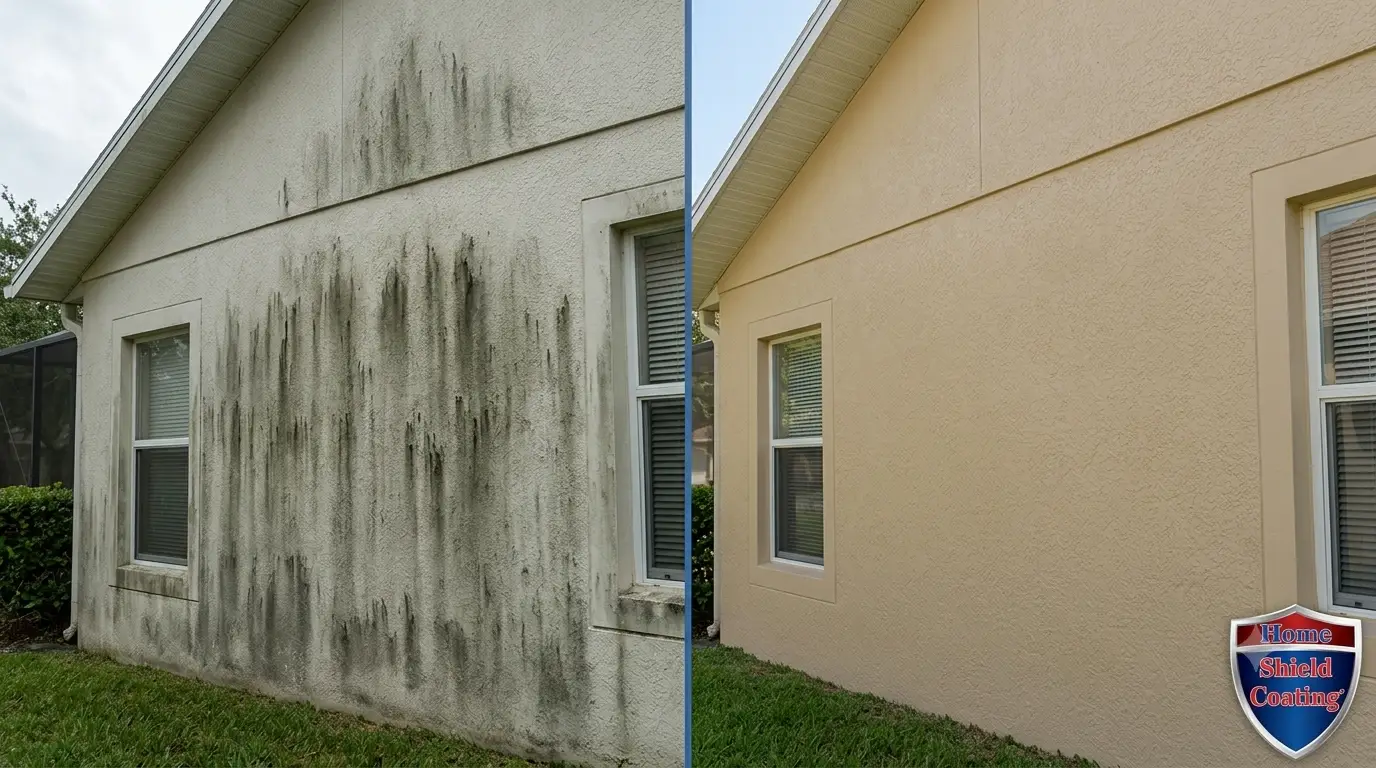
Most exterior paints marketed as “mold resistant” hold up for only 2 to 4 years in Florida before mildew wins. Home Shield Coating® has protected homes from Chicago to Central Florida since 1999, and after inspecting hundreds of mildew-stained exteriors, we can tell you exactly why this happens and what actually stops it for good. Here’s how mold-resistant paint works, what it really costs, and when a permanent coating makes more sense than another repaint.
Quick Answer: Does Mold-Resistant Paint Work in Florida?
Mold-resistant paint works, but only temporarily. EPA-registered mildewcides (zinc pyrithione or IPBC) mixed into premium 100% acrylic paints do inhibit surface mold growth but the effectiveness fades as the paint weathers, typically within 3 to 5 years even for top-tier products like Sherwin-Williams Duration or Emerald. Standard paint fails faster, often in 2 to 3 years. Home Shield Coating® offers a permanent alternative: a two part commercial grade permanent coating system thats applied at roughly 17 times the dry-film thickness of ordinary paint, creating a true waterproofing membrane that leaves mildew nowhere to take hold — backed by a 30-year transferable warranty.
- EPA-registered mildewcide should be listed on the technical data sheet — “mold-resistant” alone isn’t a regulated claim.
- Premium acrylic paints (Duration, Emerald) realistically last 3–5 years before mildew returns in Florida
- Standard paint + mildewcide additive typically fails in 2–3 years
- Our permanent coating system bridges hairline cracks and blocks moisture at the source — eliminating the repaint cycle entirely
Dealing with chronic mildew staining across the whole home? Our permanent coating system ends the mold cycle for good.
Our Home Shield Coating® Application Process
Why Florida Homes Grow Mold on Paint
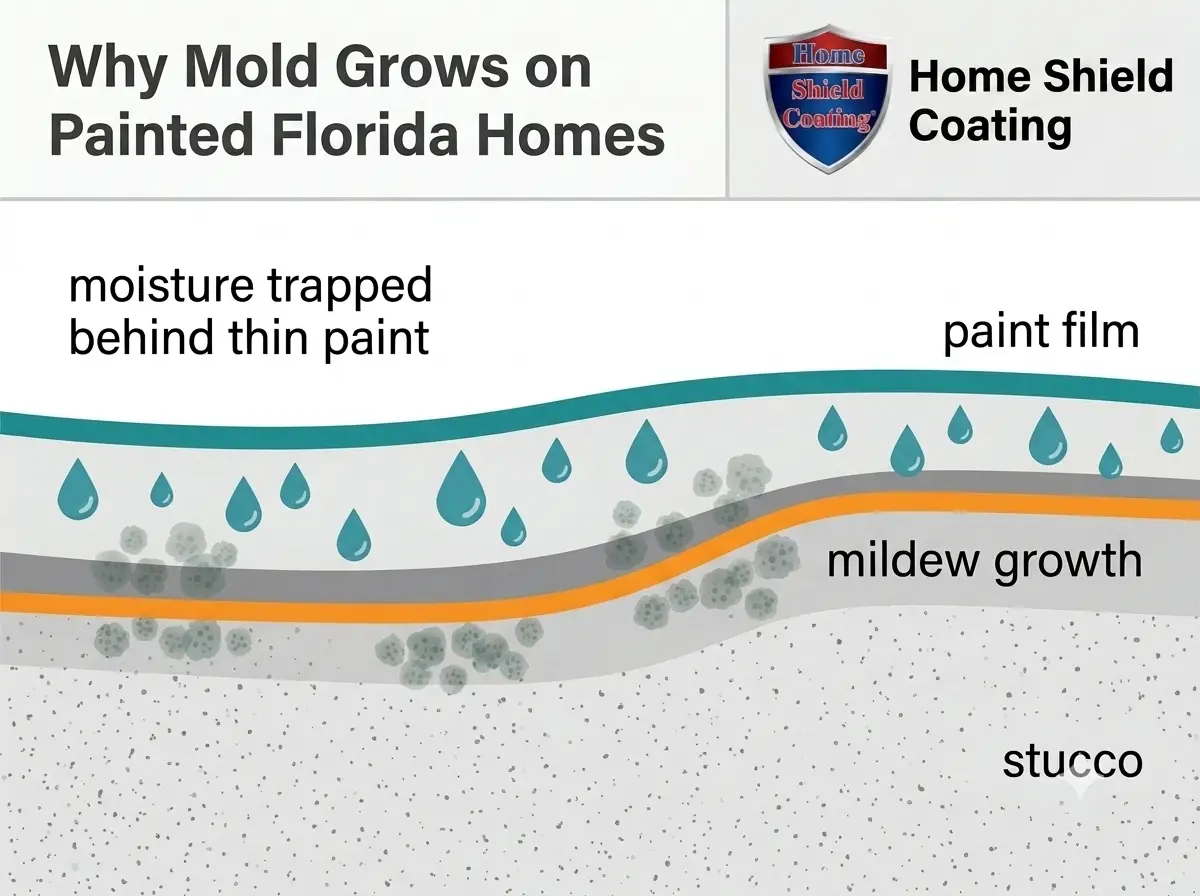
Florida’s near-constant humidity, daily afternoon thunderstorms, and intense UV exposure create an ideal environment for mold and mildew. But the paint itself is often the real problem.
Standard exterior paint is applied at roughly 2 to 3 mils of dry film thickness. In a humid climate, that thin film creates two problems:
- It doesn’t fully block moisture vapor. Water gets behind the paint film through hairline cracks, stucco pores, or seams, and becomes trapped because the film isn’t a true vapor barrier.
- It breaks down under UV and heat faster than the mildewcide additives inside it last. Most additives (zinc pyrithione, IPBC) are only rated to remain effective for a handful of years before they leach out or degrade.
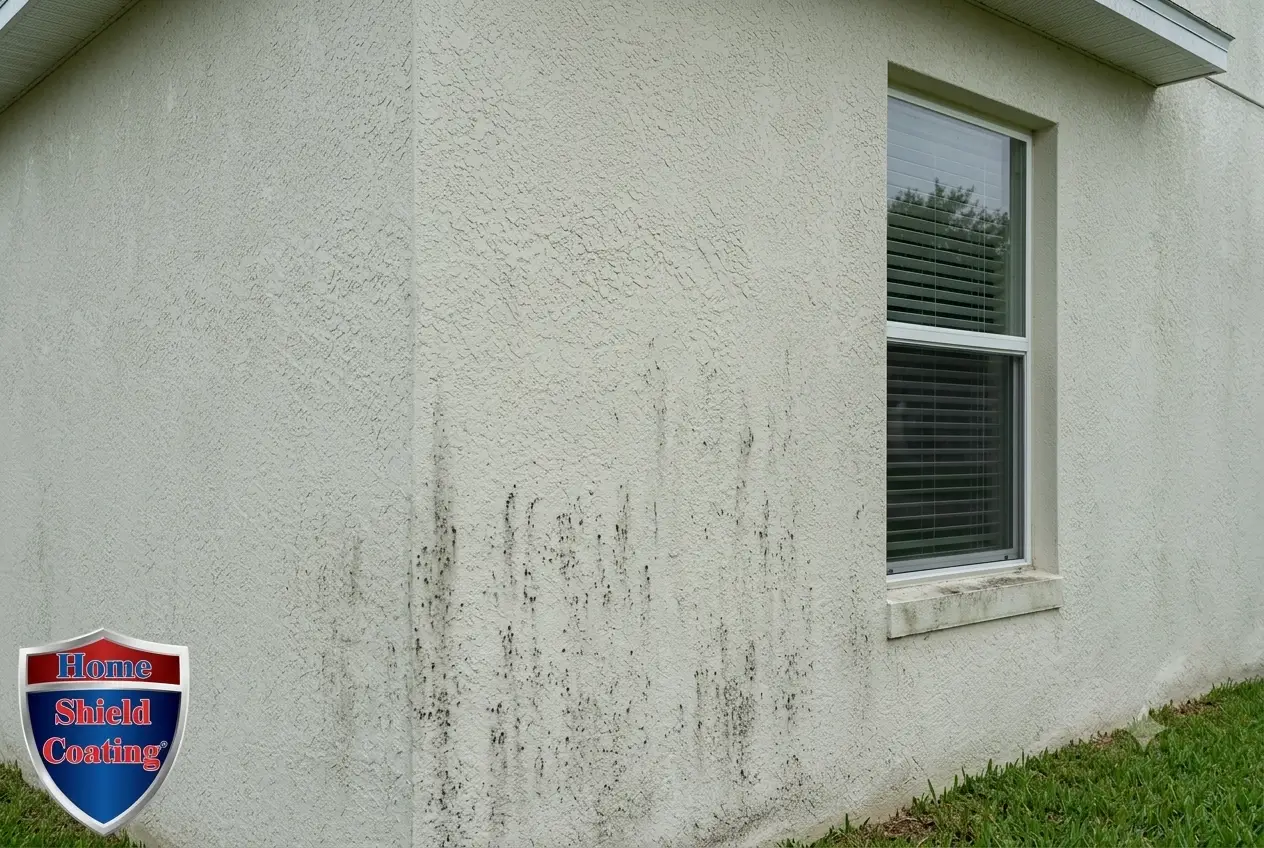
North-facing walls, areas beneath roof overhangs, and surfaces shaded by landscaping stay damp the longest after Florida’s daily rain. Those are usually the first places mildew staining appears, often within 18 to 36 months of a repaint.
How Mold-Resistant Paints Actually Work
“Mold resistant” isn’t a regulated term, so it helps to understand what is actually happening inside the can before you buy. Mold-resistant exterior paints generally work through three mechanisms:
- EPA-registered mildewcides mixed into the paint (commonly zinc pyrithione or IPBC) that inhibit fungal growth on the surface.
- Higher-quality acrylic binders that resist water absorption better than cheaper vinyl-acrylic blends.
- Self-priming, flexible formulas that resist the hairline cracking that lets moisture behind the film in the first place.
The limitation is that these additives work on the surface of the paint, not as a permanent barrier. As the finish weathers, washes, and chalks, the effective concentration of mildewcide drops. That is why even premium mold-resistant paints in Florida typically need a fresh coat within 5 to 8 years rather than lasting “forever.”
Mold-Resistant Paint Types Compared for Florida
|
Type |
How It Resists Mold |
Realistic FL Lifespan |
Best For |
|
Standard acrylic latex + mildewcide |
Surface-level mildewcide additive. |
2–3 years |
Budget repaints, low-humidity exposure. |
|
Premium 100% acrylic (Duration, Emerald tier) |
Higher solids + stronger mildewcide. package |
3–5 years |
Most Florida exteriors, moderate sun exposure. |
|
Specialty mold/mildew-proof paint (Perma-White) |
Concentrated mildewcide, marketed film guarantee. |
5 years (film) |
Shaded walls, north-facing exposure, chronic problem areas. |
|
Elastomeric paint |
Thicker film (still under 10 mils) bridges hairline cracks, reduces moisture entry. |
3–5 years |
Stucco with minor cracking. |
|
Permanent ceramic coating system (Home Shield Coating®) |
~17x thicker than ordinary paint, true waterproofing membrane, bonding primer + two topcoats. |
30-year warranty (power-wash maintenance every 7yrs) |
Homes done repainting for good. |
Best Mold-Resistant Exterior Paints for Florida in 2026
Here is an honest look at how the popular options compare, based on published manufacturer data and 2026 pricing.
Sherwin-Williams Duration Exterior — $60–$93/gallon retail. This 100% acrylic paint uses PermaLast technology and resists moisture penetration and mold/mildew growth in humid climates. It carries a limited lifetime warranty on the paint itself, but not on labor. Realistic Florida lifespan before visible mildew: 5–7 years on most exposures.
Sherwin-Williams Emerald Exterior — $80–$95/gallon retail. Emerald is the step up from Duration, with a stronger mildewcide package and a 5–7 year rated lifespan. Florida painting contractors frequently recommend it for south- and west-facing walls exposed to full sun.
Benjamin Moore Aura Exterior — $85–$119/gallon retail depending on region and finish. This premium acrylic uses Color Lock technology and is a solid performer, though it is priced well above Duration for a comparable mold-resistance profile.
Zinsser Perma-White Mold & Mildew-Proof Exterior — around $30–$45/gallon. This product makes one of the most direct “mold-proof” marketing claims on the market: the mold/mildew-resistant film is guaranteed for 5 years, while the finish itself carries a 15-year durability guarantee. It can be a good budget option for a chronically damp wall section, but the mold guarantee lasts one-third as long as the durability guarantee.
Behr Premium Plus Ultra Exterior — budget tier, roughly $35–$50/gallon. It is marketed with a mold/mildew-resistant finish, but its realistic lifespan before mildew returns is shorter at 3–5 years.
Home Shield Coating® Permanent System — not a paint. The system uses a bonding-agent primer plus two topcoats applied at approximately 17 times the dry-film thickness of ordinary paint. Instead of relying on a thin film with additives mixed in, it creates a true waterproofing membrane. It is backed by a 30-year transferable warranty. Because the system is thick enough to bridge hairline stucco cracks and keep moisture from reaching the substrate, mildew has nowhere to take hold behind the surface — the most common failure point for painted homes.
The Real Cost Math: Repainting vs. a Permanent Coating
Most mold-resistant-paint comparisons skip this section, even though it may matter most to your budget.
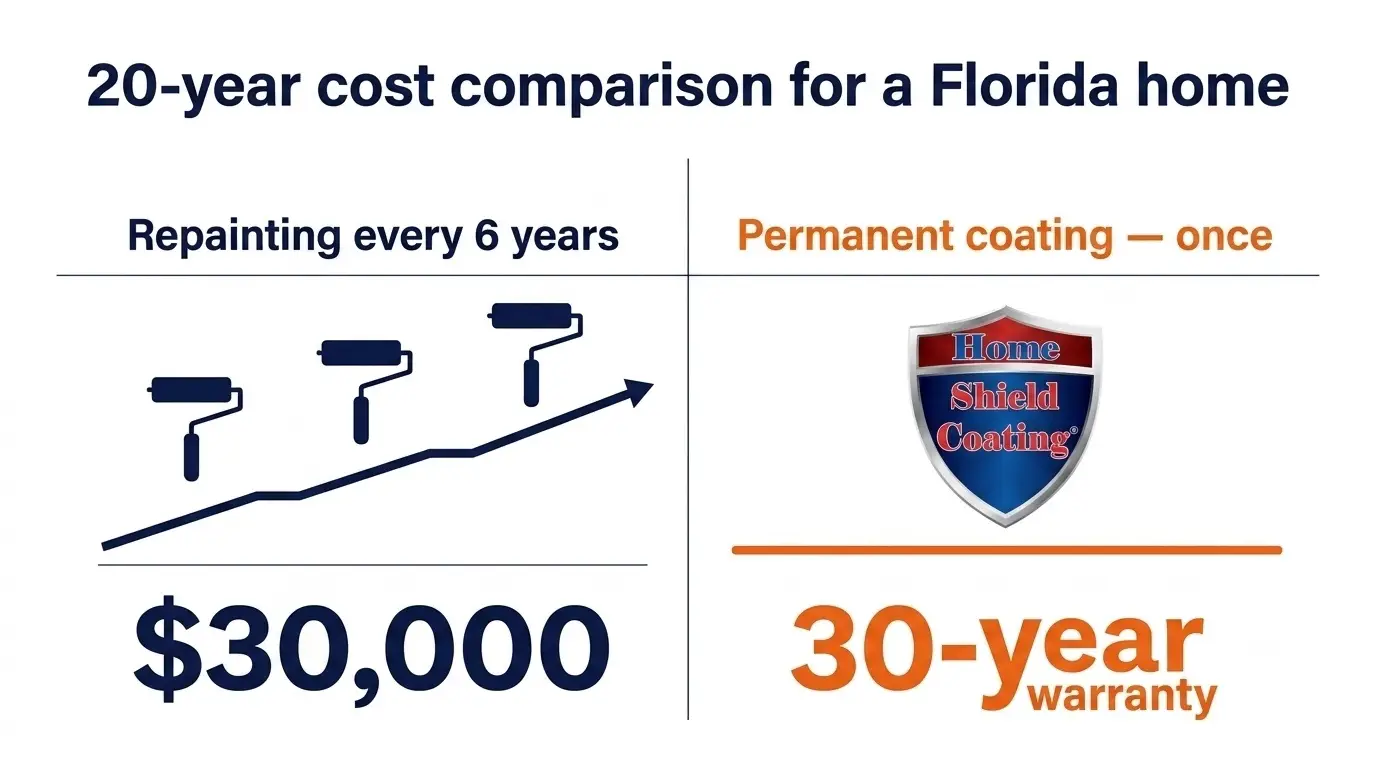
A typical Florida home repaint runs $8,000–$12,000, and even premium mold-resistant paints realistically need to be redone every 3–7 years in Florida’s climate. Over 20 years, that’s:
- Repainting every 6 years (premium paint): ~3 repaints × $10,000 average = $30,000, plus everything goes up every year the labor, prep, and disruption each time
- One permanent coating application: a single upfront cost, backed by a 30-year warranty, with no repaint cycle to budget for
Run your own numbers with our ROI calculator to see the break-even point for your specific home.
Maintenance vs. Recoating: An Important Distinction
Even with a permanent coating, Florida homes benefit from a power wash every 7 to 10 years to remove surface dirt, pollen, and airborne mildew that settles on any exterior over time. That’s routine cleaning, not recoating — the coating itself stays fully intact underneath and remains covered by the 30-year transferable warranty.
Compare that to paint: when a premium paint job hits its 5- to 8-year mark, the fix isn’t a quick wash — it’s sanding, priming, and a full $8,000–$12,000 repaint. With Home Shield Coating®, the 7- to 10-year mark is a $300 maintenance wash, not a multi-thousand-dollar redo.
What to Look for Before You Buy
Whether you choose a premium paint or a permanent coating, check these details before signing anything:
- An EPA-registered mildewcide listed on the technical data sheet — “mildew-resistant” alone on the label isn’t a regulated claim
- Breathability (perm rating) — the coating needs to let trapped moisture vapor escape, not just block it
- UV resistance data, especially for south- and west-facing walls
- A warranty that covers labor, not just materials — most paint warranties only replace the paint itself if it fails, leaving you to pay for the repaint labor
- A written product data sheet, not just marketing claims
Real Florida Projects
[Insert 1–2 real coated Florida homes with before/after photos — pull from FL job folder. Prioritize a stucco home with visible prior mildew staining if available.]
See more of our recent work in Orlando projects and across Central Florida.
Frequently Asked Questions
Does mold-resistant paint really work?
Yes, but with limits. Mold-resistant paints use EPA-registered mildewcides that inhibit surface mold growth, but the effectiveness fades as the paint weathers — typically within 5–8 years even for premium products, sooner in shaded or north-facing areas.
How long does mold-resistant paint last in Florida?
Most premium mold-resistant exterior paints last 5–8 years in Florida before mildew returns, compared to 3–5 years for standard paint. Specialty products like Zinsser Perma-White guarantee the mold-resistant film for 5 years specifically.
Can you paint over mildew?
Not without treating it first. Painting over active mildew traps it under the new film, and it will bleed through or resurface quickly. The surface needs to be cleaned with a mildewcide wash and fully dried before any repaint.
Is elastomeric paint mold-proof?
No paint is truly mold-proof. Elastomeric paint’s thicker film helps bridge hairline cracks and reduce moisture intrusion, which indirectly reduces mold risk, but it still relies on surface mildewcides that wear down over time.
What’s the best mold-resistant paint for stucco?
For stucco specifically, crack-bridging matters as much as the mildew additive. See our full breakdown in Best Exterior Paint for Stucco in Florida.
Does the Home Shield Coating® need to be redone every 7 to 10 years?
No. The coating carries a 30-year transferable warranty and does not need to be reapplied. We recommend a power wash every 7 to 10 years as routine maintenance to remove surface dirt and pollen — this is cleaning, not recoating.
Stop the Mold Cycle for Good
Tired of watching mildew creep back within a couple of years of every repaint? Get two quotes from us: one for a standard repaint and one for the Home Shield Coating® permanent system. We will walk your home, check the stucco for existing moisture and cracking, and show you the real numbers side by side.