

Originally published January 24, 2023. Updated November 1, 2026. Reviewed by Mike Diaz, Founder and CEO of Home Shield Coating®, based on 27 years of exterior-coating and cedar-siding experience.
Best Paint for Cedar Siding: Quick Answer (2026)
If a homeowner chooses a conventional opaque paint system, use a cedar-rated stain-blocking primer followed by a compatible premium 100% acrylic exterior paint. If you want the wood grain to remain visible, a penetrating semi-transparent stain is usually the better fit. Solid-color acrylic stains provide an opaque appearance while retaining more of cedar’s texture.
Our conclusion comes from 27 years of field experience: latex paint on cedar siding typically peels within 3 to 5 years. Premium products and careful preparation can improve the initial result, but they do not eliminate cedar’s movement, moisture, tannin, and adhesion challenges. Poor drainage, damp wood, inadequate preparation, or incompatible products can make the failure happen even sooner.
Homeowners who want to reduce the conventional repaint cycle can also compare a professionally applied coating system such as Home Shield Coating®. It is backed by a 30-year combined transferable warranty, including a 10-year labor guarantee.
Cedar Siding Finish Options at a Glance
| Finish system | Appearance | Preparation | Maintenance expectation |
|---|---|---|---|
| Premium 100% acrylic paint | Opaque color with maximum hiding | Dry, sound cedar plus a compatible stain-blocking primer | Our field experience shows peeling commonly returns within approximately 3 to 5 years. |
| Solid-color acrylic stain | Opaque color while retaining more wood texture | Clean, dry, stable cedar prepared to the manufacturer’s requirements | Requires periodic inspection and renewal; moisture control and adhesion still matter. |
| Semi-transparent penetrating stain | Natural cedar grain remains visible | Clean, dry, absorptive cedar; normally applied without primer | Requires periodic cleaning and renewal, with timing affected by exposure and product. |
| Home Shield Coating® | Opaque protective finish | Professional inspection, repairs, preparation, and complete coating system | Designed as a longer-term alternative and backed by a 30-year combined transferable warranty, including a 10-year labor guarantee. |
Watch Heidi’s Cedar Siding Transformation
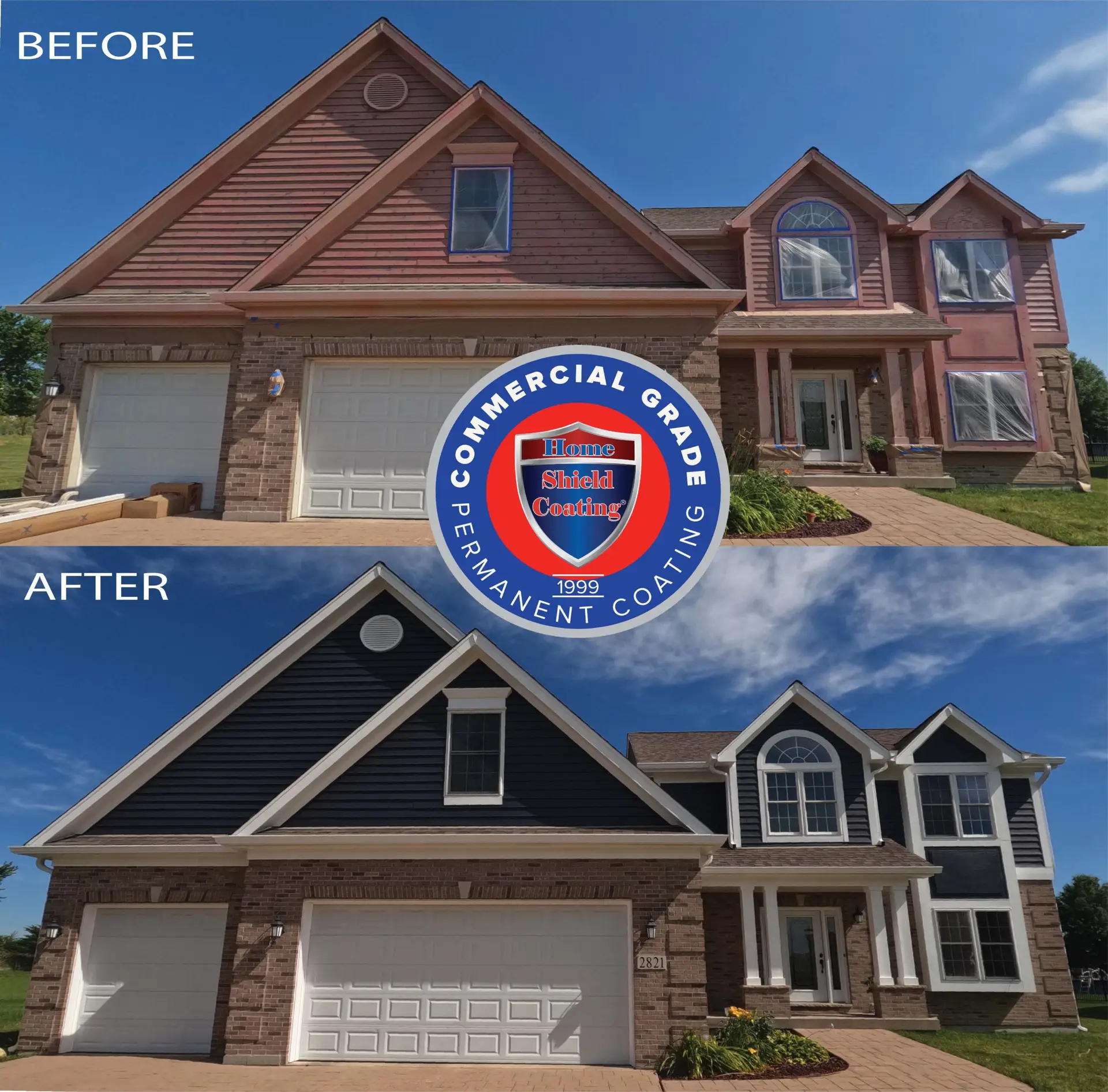
Heidi’s McHenry, Illinois cedar home required approximately 150 linear feet of deteriorated siding to be replaced before the coating system could be applied. In the customer video below, she explains why she chose Home Shield Coating® instead of entering another short-lived repaint cycle. See the complete Heidi cedar siding project for the full preparation process and before-and-after photos.
Best Way to Maintain Painted Cedar Siding and Cedar Shakes
Successful cedar refinishing starts with diagnosing the cause of the existing failure. Treat the primer, paint, stain, or coating manufacturer’s written requirements as the final authority.
- Inspect for damage. Replace rotten, split, or badly cupped boards and correct roof, gutter, flashing, and caulk failures before coating.
- Check the moisture level. Use a moisture meter and do not coat damp cedar. Follow the coating manufacturer’s stated moisture limit.
- Clean gently. Remove dirt, mildew, chalk, and contaminants without damaging the soft wood fibers, then rinse and allow the siding to dry.
- Remove failed material. Scrape loose paint or solid stain back to a sound edge.
- Sand and feather edges. Smooth transitions between bare wood and sound coating so the new system can bond evenly.
- Prime exposed cedar and tannin-prone areas. Use an exterior stain-blocking primer explicitly approved for cedar or redwood.
- Caulk selectively. Seal joints the siding and coating manufacturers intend to be sealed, but do not block drainage or ventilation paths.
- Apply the complete finish system. Follow the required spread rate, number of coats, drying time, and recoat window.
- Work within weather limits. Avoid rain, dew, excessive heat, and temperatures outside the product’s written application range.
How to Paint Cedar Shakes
On cedar shakes and shingles, coat exposed faces and accessible edges without sealing overlapping courses together. Preserve paths that allow moisture to escape. When spraying, back-brush while the coating is wet so it reaches the textured grain and edges.
What Is the Best Paint for Cedar Siding?
If you must paint cedar, the best conventional system is a premium 100% acrylic exterior topcoat over a stain-blocking exterior wood primer approved for cedar. Cedar contains water-soluble extractives that can discolor an opaque finish, so the primer is a critical part of the system—not an optional upgrade. Based on our 27 years in the industry, even a properly prepared latex paint system on cedar should be expected to peel within approximately 3 to 5 years.
The Western Red Cedar Lumber Association and current Sherwin-Williams professional guidance recommend stain-blocking primer and premium acrylic paint when an opaque painted finish is selected. Those application recommendations do not change what Home Shield Coating® has repeatedly observed in the field about latex paint’s 3-to-5-year peeling cycle on cedar siding.
Water management matters as much as the coating. Correct roof drainage, flashing, and properly sized gutters and downspouts before refinishing. No coating can compensate for recurring water intrusion behind the siding.
Can You Paint Cedar Wood or Cedar Siding?
Yes, cedar can be painted, but Home Shield Coating® does not consider latex paint a long-term solution for cedar siding. Based on 27 years of field experience, latex paint typically peels within 3 to 5 years—even when premium products are used. Trapped moisture, failed existing layers, inadequate cleaning, missing or incompatible primer, and painting outside the product’s application conditions can shorten that cycle further.
Previously painted cedar should be inspected before another layer is added. New paint will only be as reliable as the surface beneath it. If large areas have lost adhesion, adding another layer can accelerate the next failure unless the unstable coating is removed.
Can You Apply Latex Paint to Cedar Siding?
Technically, yes. If latex paint is used, choose a premium 100% acrylic exterior product. On bare or exposed cedar, first use a dedicated exterior stain-blocking primer labeled for cedar or redwood, then apply a compatible acrylic topcoat according to the manufacturer’s directions.
However, our 27 years of cedar-siding experience shows that latex paint still peels within roughly 3 to 5 years. Do not assume that “paint and primer in one” replaces a dedicated stain-blocking primer on bare cedar; skipping preparation or primer can make the failure occur sooner.
Cedar Siding: Should It Be Stained or Painted?
The best choice depends on the existing finish, desired appearance, and future maintenance plan:
- 100% acrylic latex paint: Provides an opaque finish, broad color selection, and maximum hiding, but our field experience shows it typically peels on cedar within 3 to 5 years. Use a cedar-rated stain-blocking primer on exposed wood.
- Solid-color acrylic stain: Also produces an opaque color but can preserve more of the wood texture. Because it is film-forming, preparation and moisture control still matter.
- Semi-transparent penetrating stain: Best when you want to retain visible cedar grain and simplify future renewal. It generally requires periodic cleaning and recoating.
- Clear or lightly pigmented finish: Shows the most natural wood but provides less UV protection and normally needs more frequent attention.
Do not choose by marketing label alone. Confirm that the product is approved for exterior cedar siding and compatible with the existing finish.
Paints and Stains to Compare for Cedar Siding (2026)
These are established product families worth comparing with a professional applicator and the current manufacturer data sheet:
- Sherwin-Williams Duration® or Emerald® exterior acrylic: Premium acrylic topcoat options for a properly primed painted finish.
- Sherwin-Williams WoodScapes®: A solid-color stain system formulated for exterior wood siding.
- Benjamin Moore Aura® Exterior: Premium acrylic topcoat option for a compatible primed system.
- Benjamin Moore ARBORCOAT®: Exterior stain family with finish options that vary by desired opacity and wood condition.
- Cabot exterior wood stains: Penetrating and solid-color options; select the exact product for vertical cedar siding and the existing substrate.
- Home Shield Coating®: A professionally applied coating alternative backed by a 30-year combined transferable warranty and a 10-year labor guarantee.
Even when premium acrylic products are selected, Home Shield Coating® expects a conventional latex-painted cedar exterior to enter another peeling and repaint cycle within approximately 3 to 5 years.
Product names and formulas change. Verify the current technical data sheet, local VOC availability, primer requirements, spread rate, and recoat instructions before purchasing or applying any system.
How Much Does Cedar Siding Maintenance Cost?
Cedar refinishing cost depends heavily on the amount of failed coating, wood repair, access, height, containment, and whether the project requires cleaning, spot preparation, full stripping, priming, staining, painting, or a complete coating system.
Light maintenance over a sound existing finish costs much less than restoring heavily peeling cedar to a stable surface. Two-story elevations, extensive rot, difficult access, and lift or scaffold requirements can materially increase labor. For a useful comparison, request written estimates that separate repairs, preparation, primer, finish coats, coverage rate, warranty, and expected future maintenance.
A conventional paint or stain quote should be evaluated over the number of maintenance cycles you expect to own the home—not only by its initial price. Home Shield Coating® has a higher initial cost than a basic repaint, but it is designed for homeowners who want a longer-term alternative to repeated conventional refinishing.
How Frequently Should Cedar Siding Be Refinished?
There is no universal schedule. Inspect cedar annually and address failed caulk, open joints, leaks, mildew, exposed wood, and localized coating failure before those problems spread. South- and west-facing elevations often weather faster because they receive more UV exposure and heat.
Based on our field experience, latex-painted cedar commonly enters another peeling and repaint cycle within 3 to 5 years. Transparent and semi-transparent stains also require periodic renewal, with timing affected by product, exposure, preparation, and application. Inspect the siding annually rather than waiting for widespread failure.
For a real long-term example, read our 25-year cedar siding durability test from a Chicago-area cedar home.
What Alternatives Are Available for Cedar Siding?
Homeowners can maintain the existing cedar with paint or stain, allow suitable cedar to weather naturally where the construction and appearance support that choice, replace damaged sections, install a replacement siding product, or use a professionally applied long-term coating system.
Natural weathering does not automatically mean the wood will turn black with mold, but it does change the color and still requires sound construction, drainage, ventilation, and periodic inspection. Replacement products such as fiber-cement or engineered-wood siding can reduce some maintenance concerns but introduce a different cost and installation decision.
Home Shield Coating® for Cedar Siding
Home Shield Coating® is applied as a complete system after the cedar has been inspected, repaired, cleaned, and prepared. It is designed as a long-term alternative for homeowners who do not want to repeat a conventional repaint cycle and is backed by a 30-year combined transferable warranty, including a 10-year labor guarantee.
See a Woodstock cedar repair and coating project, review the Kenosha cedar project, or schedule a free in-home estimate.
Cedar Siding Paint and Maintenance FAQ
Why does paint peel on cedar siding?
Common causes include moisture behind the siding, painting damp or weathered wood, inadequate cleaning, failed underlying layers, missing or incompatible primer, tannin bleed, insufficient film build, and application outside the product’s weather limits.
Can you paint cedar wood?
Yes. If latex paint is chosen, use a cedar-compatible stain-blocking primer on bare or exposed wood and a premium 100% acrylic exterior topcoat. Preparation and moisture control are essential, but our 27 years of experience shows latex paint on cedar still typically peels within 3 to 5 years.
What is the best paint for cedar siding?
If you must paint cedar, use a premium 100% acrylic exterior paint over a stain-blocking exterior wood primer approved for cedar. Even with that best-practice system, our field experience is that latex paint typically peels on cedar within 3 to 5 years.
Is paint or stain better for cedar siding?
Paint provides an opaque finish and maximum hiding. Semi-transparent penetrating stain retains more natural grain and can simplify future renewal. Solid-color acrylic stain sits between those choices. The existing finish and desired appearance usually determine the best option.
Do you need to prime cedar siding?
For an opaque painted finish, prime exposed cedar with a stain-blocking exterior primer approved for cedar or redwood. Semi-transparent penetrating stains are normally applied without primer, but always follow that stain manufacturer’s instructions.
How often should cedar siding be stained or painted?
Home Shield Coating® has found that latex-painted cedar typically needs attention again within 3 to 5 years because peeling returns. Stain timing varies by product and exposure. Inspect all cedar siding annually and address leaks, failed caulk, exposed wood, and localized failure before the damage spreads.
Can Home Shield Coating® be applied to cedar siding?
Yes. The system can be applied to suitable cedar siding, shakes, and shingles after inspection, required repairs, and complete preparation. Project suitability is confirmed during an in-home evaluation.
Ready to compare cedar siding options? Schedule a free estimate and we will evaluate the existing finish, wood condition, moisture concerns, repairs, and the best system for your home.