
Quick answer Elastomeric paint can be a good choice for stucco, concrete block, and other masonry walls, but it is not a shortcut around repairs. It performs best when the wall is dry, sound, properly flashed, and prepared to the coating manufacturer’s specifications. Put it over an active leak or damp masonry, and the same thick film that blocks rain can blister or peel as trapped moisture pushes outward.
Homeowners often hear “use elastomeric” as a catch-all answer for cracked stucco or porous block. Sometimes that advice is right. Other times it hides the real problem for a few seasons and leaves the homeowner with sheets of peeling coating. The difference comes down to the wall, the water source, the primer, the finished film thickness, and the crew applying it.
What Elastomeric Paint Is
Elastomeric means elastic. An elastomeric wall paint is a high-build acrylic coating made to stretch and recover as stucco or masonry moves. That extra thickness helps it span small surface cracks that ordinary exterior paint would simply copy.
The exact numbers vary by product, so the product data sheet should control every job. As a category, elastomeric wall coatings usually share four traits:
- More solids remain on the wall. Many elastomerics contain roughly 45 to 60 percent solids by volume.
- They build a much thicker film. Many systems are specified around 10 to 20 dry mils per coat, while ordinary exterior paint is much thinner.
- They stretch. Depending on the formulation, elongation may range from about 150 percent to several hundred percent.
- They cover less area per gallon. A full-thickness coat may cover only about 60 to 100 square feet per gallon, compared with several hundred square feet for conventional paint.
Elastomeric Paint Compared With Acrylic Exterior Paint
| Feature | Regular Acrylic Exterior Paint | Elastomeric Wall Paint |
|---|---|---|
| Film build | Thin maintenance finish | High-build protective film |
| Movement | Limited stretch | Designed to stretch and recover |
| Hairline cracks | Usually telegraphs the crack | Can bridge small, nonstructural cracks |
| Coverage | Often several hundred sq ft per gallon | Often about 60 to 100 sq ft per gallon at full build |
| Vapor movement | Usually more open | Varies widely; check the perm rating |
| Application | Commonly one or two finish coats | Specified primer and multiple full-thickness coats may be required |
These are planning comparisons, not universal specifications. Some modern elastomeric coatings are quite vapor permeable, while others form a much tighter film. Always compare the current product data sheets.
Where Elastomeric Paint Works Best
- Sound stucco with hairline cracking. A flexible film can span small surface cracks that would reappear through ordinary paint.
- Above-grade concrete block walls. Block can be an excellent substrate once pinholes are filled and the wall is properly primed.
- Poured and tilt-up concrete. Large masonry surfaces often benefit from a flexible, weather-resistant coating when the substrate is dry and stable.
- Walls with working flashing and drainage. A coating performs best when roofs, windows, gutters, kick-out flashing, and wall drainage are already directing water away from the building.
Bare Block Needs Block Filler
Unpainted concrete block is full of pores and pinholes. Before the finish coats go on, the wall normally needs a compatible block filler or masonry primer. The filler closes the surface so the elastomeric coating can form a continuous film instead of bridging thousands of tiny voids. The spread rate and cure time should come from the filler manufacturer’s data sheet.
Why Elastomeric Paint Can Trap Moisture
It can happen, but it is not true of every product. Vapor permeability differs widely among elastomeric coatings. The risk rises when a low-perm product is installed over a damp wall or when water keeps entering through a window, roof-to-wall connection, failed sealant joint, overflowing gutter, or plumbing leak.
The Northwest Wall and Ceiling Bureau recommends breathable coatings for stucco and points to a perm rating of 7 or higher as a useful benchmark. That is why the perm rating matters just as much as elongation and film thickness. A coating should shed liquid water while still allowing water vapor to escape from the wall assembly.
Warning signs include
- Bubbles or blisters, especially on walls heated by afternoon sun
- Coating that releases in sheets instead of small flakes
- Mold or mildew appearing through or behind the finish
- White efflorescence collecting around cracks or at the base of the wall
Before any coating goes on, the water source needs to be found and corrected. No wall coating, including Home Shield Coating®, should be used to cover an active leak.
Why Elastomeric Paint Jobs Fail
The most common failures are installation failures. A high-build product has to be applied at the specified thickness, over the right primer, within the correct weather window. Cutting the material or rushing the job changes the coating the manufacturer tested.
- The product is thinned. Adding water makes the coating easier to spray or roll but reduces the dry film left on the wall.
- Too little material is used. A large wall area covered with a surprisingly small number of gallons is a warning sign.
- One heavy coat replaces the specified system. Heavy application can sag, run, skin over, or cure unevenly. Many systems require two full coats.
- Crack repairs are skipped. Elastomeric paint can bridge hairline cracks. It cannot repair structural movement, loose stucco, or open joints.
- Primer or block filler is omitted. A finish coat cannot make up for a weak, chalky, or porous surface.
- A damp wall is coated. Moisture trapped behind a dense film can create pressure that lifts the coating.
A useful question for any contractor Ask what dry-film thickness the price includes and how many gallons the wall area requires. A clear answer should match the product data sheet and the square footage.
Cost and Expected Service Life
Elastomeric paint costs more than standard acrylic paint because each gallon covers less area and the wall often needs extra repair, primer, and finish coats. Published Florida cost guides commonly place elastomeric material around $60 to $80 per gallon, but product grade and contractor pricing vary. At full film build, the coating may use four to six times as many gallons as ordinary paint.
As a broad planning range, a properly specified elastomeric job may cost roughly two to three times as much as a basic repaint. The wall condition, access, repairs, primer, product, and finished thickness matter more than the price printed on a pail.
A well-applied elastomeric system on a dry, sound wall can last 10 years or longer. Some manufacturers offer 10-year material warranties. Those numbers assume the wall was repaired, the correct primer was used, and the coating reached its specified film thickness.
How Home Shield Coating® Is Different
Home Shield Coating® is not a single pail of conventional elastomeric paint. It is a two-part coating system installed in three sprayed coats. Our crews use professional airless equipment rather than rolling the finish.
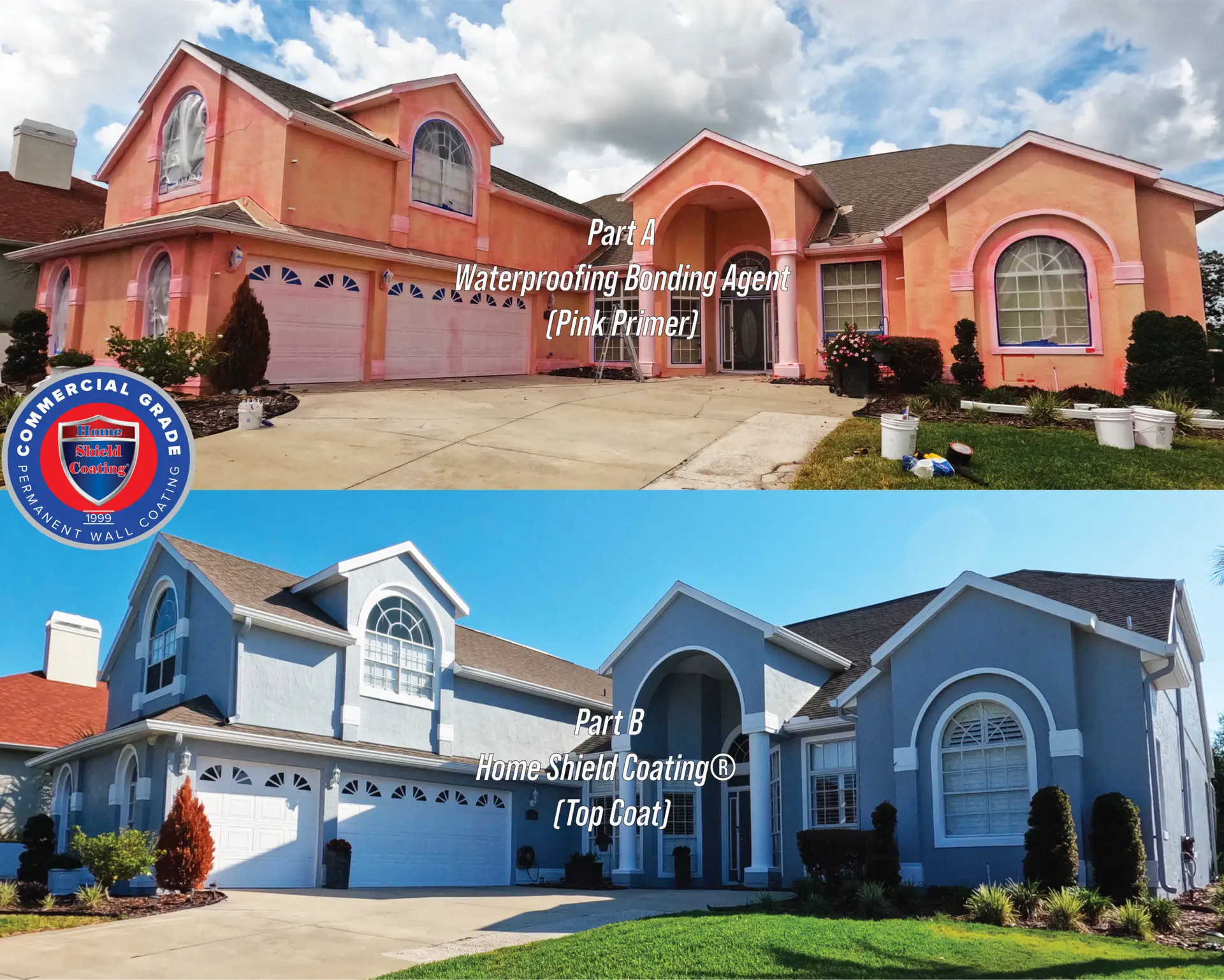
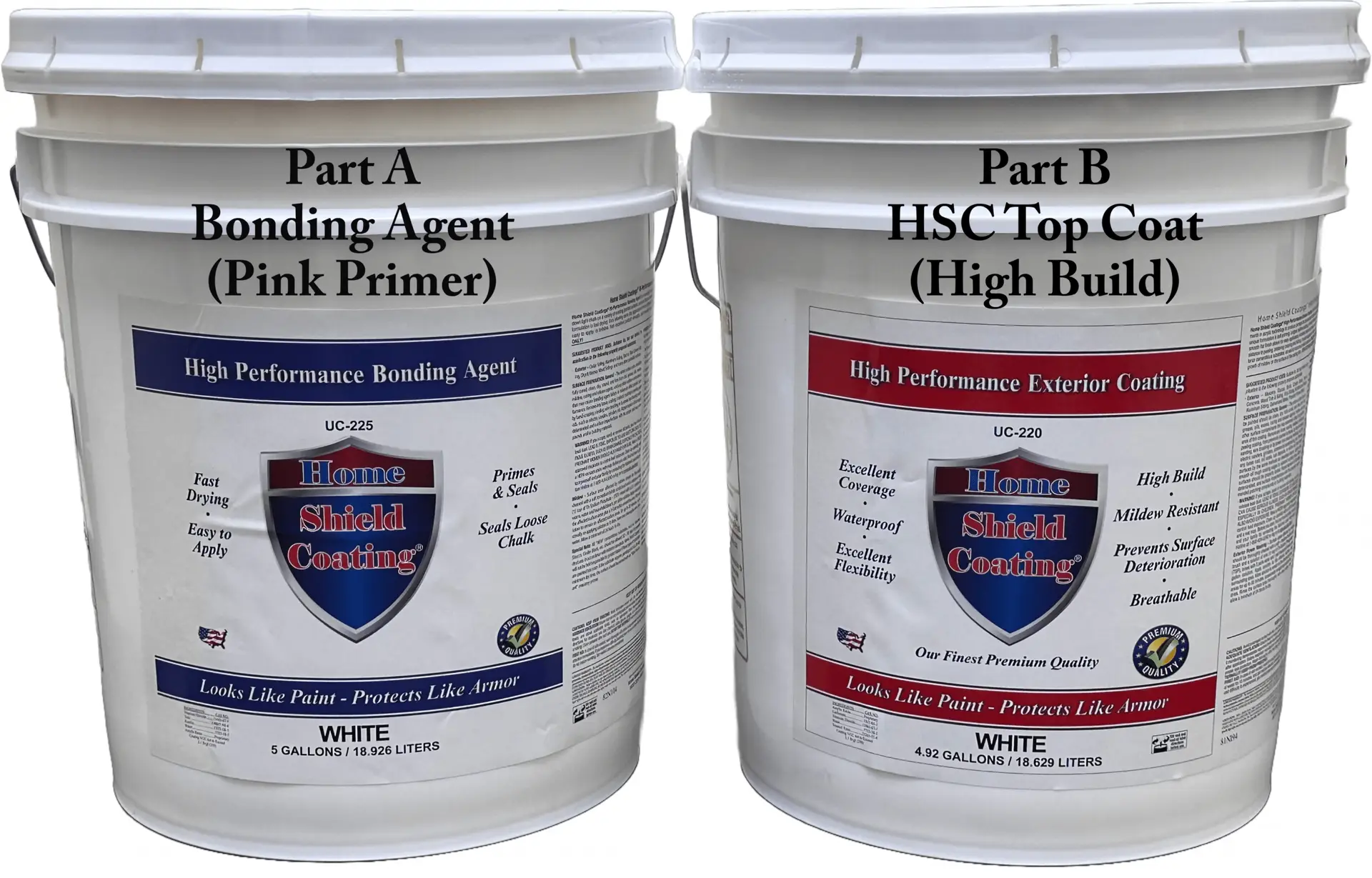
- Part A is the pink waterproof bonding agent primer. We spray it onto the prepared surface so it can penetrate, seal, and create the tacky bond needed for the finish coats.
- Part B is the Home Shield Coating® topcoat. We spray two controlled coats in the homeowner’s selected color to build the flexible exterior membrane.
The completed system is designed to block liquid water from the outside while allowing vapor to escape. It is applied approximately 17 times thicker than ordinary paint and is backed on qualifying residential projects by a transferable 30-year combined warranty, including 10 years of labor and material coverage followed by 20 years of material coverage.
Standard Elastomeric Paint Compared With Home Shield Coating®
| Feature | Standard Elastomeric Wall Paint | Home Shield Coating® |
|---|---|---|
| System | Product-specific primer plus finish coats | Part A bonding primer plus two Part B topcoats |
| Application | Brush, roller, or spray depending on product | Professionally sprayed with airless equipment |
| Moisture plan | Depends on the product’s perm rating and wall condition | Designed to block liquid water while allowing vapor to escape |
| Thickness | Varies by product and specification | Approximately 17 times thicker than ordinary paint |
| Warranty | Often product-specific and material-only | 30-year combined transferable warranty |
| Primary goal | Longer-lasting masonry finish | A permanent alternative to the repaint cycle |
Neither system belongs over an unresolved leak. We inspect the walls, identify visible water-entry points, and explain the repairs required before coating begins.
Questions to Ask Before Choosing a Coating
- What dry-film thickness is included in the proposal, and how many gallons will the job require?
- What is the product’s vapor-permeability or perm rating?
- How will cracks larger than hairline be repaired?
- What primer or block filler will be used before the finish coats?
- How many coats are specified, and how much drying time is required between them?
- Does the warranty cover labor as well as material?
Frequently Asked Questions
Is Home Shield Coating® an elastomeric paint?
Not exactly our advanced formulation is a two part industrial coating that utilizes hybrid copolymer resins engineered through the controlled cross-linking of acrylic and methacrylic monomers, enabling precise resistance to thermal, mechanical, and chemical wear.
To ensure a permanent bond, Home Shield Coating® is applied over a proprietary, surface-penetrating bonding agent (Pink Primer) that creates a tacky, high-adhesion anchor layer on complex substrates. Once cured, it forms a permanent protective shield that stops even the most brutal hurricane-force, wind-driven rain and extreme weather right in its tracks.
The cured membrane delivers exceptional tensile strength and up to 300% elongation, allowing it to expand and contract with the substrate and bridge hairline fractures before they migrate into visible cracks. Formulated as a high-solids, low-VOC system, Home Shield Coating® pairs superior vapor transmission (breathability) with a permanent moisture barrier — so trapped humidity escapes while wind-driven rain, UV, and freeze-thaw cycling stay locked out.
Is elastomeric paint waterproof
It sheds liquid water well when it is applied to a properly prepared wall at the specified thickness. It does not repair failed flashing, leaking windows, bad gutters, open joints, or structural cracks.
Does elastomeric paint trap moisture in stucco
It can. The risk depends on the product’s perm rating, the moisture already in the wall, and whether water continues to enter from another source. A breathable coating and a dry, repaired wall are both important.
Can elastomeric paint go over existing paint
Usually, if the existing paint is sound, clean, compatible, and firmly bonded. Loose, chalky, or peeling material must be removed. A heavy elastomeric film can pull weak paint away from the wall.
How long does elastomeric paint last
Seven to Ten years or longer is possible on a sound wall with correct repairs, primer, film thickness, and moisture control. Poor preparation or an active water problem can shorten that life dramatically.
Can elastomeric paint be applied by a homeowner
It can, but meeting the specified wet and dry film thickness takes more material and more coats than most homeowners expect. Thinning the product or stretching the coverage too far is a common DIY failure.
What is the difference between elastomeric paint and block filler
Block filler is a primer made to fill pores and pinholes in bare concrete block. Elastomeric paint is the weather-exposed finish. On bare block, the compatible filler or masonry primer comes first.
Get an Honest Assessment of Your Walls
If your stucco or block walls are cracking, chalking, taking on water, or needing another repaint after only a few years, we will inspect the exterior and explain what we find. We can compare a standard paint job with a permanent Home Shield Coating® system so you can see the preparation, warranty, and long-term cost difference.
Call us at (800) 330-9651. You can also request a free estimate online.
Sources
- SikaWall 4090 Elastomeric Coating product data sheet
- PAREX Elastomeric Finish product data sheet
- Northwest Wall and Ceiling Bureau Painting Stucco guidance
- HUD concrete masonry construction report
- Fixr Florida exterior painting cost guide
- Home Shield Coating® pricing guide
- Home Shield Coating® permanent exterior wall coating guide
- Home Shield Coating® stucco waterproofing guide