

Quick answer Elastomeric paint can be a good choice for stucco, concrete block, and other masonry walls, but it is not a shortcut around repairs. It performs best when the wall is dry, sound, properly flashed, and prepared to the coating manufacturer’s specifications. Put it over an active leak or damp masonry, and the same thick film that blocks rain can blister or peel as trapped moisture pushes outward.
Homeowners often hear “use elastomeric” as a catch-all answer for cracked stucco or porous block. Sometimes that advice is right. Other times it hides the real problem for a few seasons and leaves the homeowner with sheets of peeling coating. The difference comes down to the wall, the water source, the primer, the finished film thickness, and the crew applying it.
What Elastomeric Paint Is
Elastomeric means elastic. An elastomeric wall paint is a high-build acrylic coating made to stretch and recover as stucco or masonry moves. That extra thickness helps it span small surface cracks that ordinary exterior paint would simply copy.
The exact numbers vary by product, so the product data sheet should control every job. As a category, elastomeric wall coatings usually share four traits:
- More solids remain on the wall. Many elastomerics contain roughly 45 to 60 percent solids by volume.
- They build a much thicker film. Many systems are specified around 10 to 20 dry mils per coat, while ordinary exterior paint is much thinner.
- They stretch. Depending on the formulation, elongation may range from about 150 percent to several hundred percent.
- They cover less area per gallon. A full-thickness coat may cover only about 60 to 100 square feet per gallon, compared with several hundred square feet for conventional paint.
Elastomeric Paint Compared With Acrylic Exterior Paint
| Feature | Regular Acrylic Exterior Paint | Elastomeric Wall Paint |
|---|---|---|
| Film build | Thin maintenance finish | High-build protective film |
| Movement | Limited stretch | Designed to stretch and recover |
| Hairline cracks | Usually telegraphs the crack | Can bridge small, nonstructural cracks |
| Coverage | Often several hundred sq ft per gallon | Often about 60 to 100 sq ft per gallon at full build |
| Vapor movement | Usually more open | Varies widely; check the perm rating |
| Application | Commonly one or two finish coats | Specified primer and multiple full-thickness coats may be required |
These are planning comparisons, not universal specifications. Some modern elastomeric coatings are quite vapor permeable, while others form a much tighter film. Always compare the current product data sheets.
Where Elastomeric Paint Works Best
- Sound stucco with hairline cracking. A flexible film can span small surface cracks that would reappear through ordinary paint.
- Above-grade concrete block walls. Block can be an excellent substrate once pinholes are filled and the wall is properly primed.
- Poured and tilt-up concrete. Large masonry surfaces often benefit from a flexible, weather-resistant coating when the substrate is dry and stable.
- Walls with working flashing and drainage. A coating performs best when roofs, windows, gutters, kick-out flashing, and wall drainage are already directing water away from the building.
Bare Block Needs Block Filler
Unpainted concrete block is full of pores and pinholes. Before the finish coats go on, the wall normally needs a compatible block filler or masonry primer. The filler closes the surface so the elastomeric coating can form a continuous film instead of bridging thousands of tiny voids. The spread rate and cure time should come from the filler manufacturer’s data sheet.
Why Elastomeric Paint Can Trap Moisture
It can happen, but it is not true of every product. Vapor permeability differs widely among elastomeric coatings. The risk rises when a low-perm product is installed over a damp wall or when water keeps entering through a window, roof-to-wall connection, failed sealant joint, overflowing gutter, or plumbing leak.
The Northwest Wall and Ceiling Bureau recommends breathable coatings for stucco and points to a perm rating of 7 or higher as a useful benchmark. That is why the perm rating matters just as much as elongation and film thickness. A coating should shed liquid water while still allowing water vapor to escape from the wall assembly.
Warning signs include
- Bubbles or blisters, especially on walls heated by afternoon sun
- Coating that releases in sheets instead of small flakes
- Mold or mildew appearing through or behind the finish
- White efflorescence collecting around cracks or at the base of the wall
Before any coating goes on, the water source needs to be found and corrected. No wall coating, including Home Shield Coating®, should be used to cover an active leak.
Why Elastomeric Paint Jobs Fail
The most common failures are installation failures. A high-build product has to be applied at the specified thickness, over the right primer, within the correct weather window. Cutting the material or rushing the job changes the coating the manufacturer tested.
- The product is thinned. Adding water makes the coating easier to spray or roll but reduces the dry film left on the wall.
- Too little material is used. A large wall area covered with a surprisingly small number of gallons is a warning sign.
- One heavy coat replaces the specified system. Heavy application can sag, run, skin over, or cure unevenly. Many systems require two full coats.
- Crack repairs are skipped. Elastomeric paint can bridge hairline cracks. It cannot repair structural movement, loose stucco, or open joints.
- Primer or block filler is omitted. A finish coat cannot make up for a weak, chalky, or porous surface.
- A damp wall is coated. Moisture trapped behind a dense film can create pressure that lifts the coating.
A useful question for any contractor Ask what dry-film thickness the price includes and how many gallons the wall area requires. A clear answer should match the product data sheet and the square footage.
Cost and Expected Service Life
Elastomeric paint costs more than standard acrylic paint because each gallon covers less area and the wall often needs extra repair, primer, and finish coats. Published Florida cost guides commonly place elastomeric material around $30 to $60 per gallon, but product grade and contractor pricing vary. At full film build, the coating may use roughly three to five times as many gallons as ordinary paint.
As a planning range, expect to pay a premium over a standard acrylic repaint rather than a multiple of it. Our 2026 pricing guide lists elastomeric on Florida stucco at about $5.00 to $6.50 per square foot versus $4.75 to $6.00 for premium acrylic latex. Most of that premium is material and primer, because each gallon covers far less wall and the primer step is not optional.
Manufacturers often cite 10-year material warranties, but in Florida sun and humidity we typically see over-the-counter elastomeric repaints needed again in about 5 to 7 years, and sooner on exposed walls. Even the longer numbers assume the wall was repaired, the correct primer was used, and the coating reached its specified film thickness.
How Home Shield Coating® Is Different
Home Shield Coating® is not a single pail of conventional elastomeric paint. It is a two-part coating system installed in three sprayed coats. Our crews use professional airless equipment rather than rolling the finish.
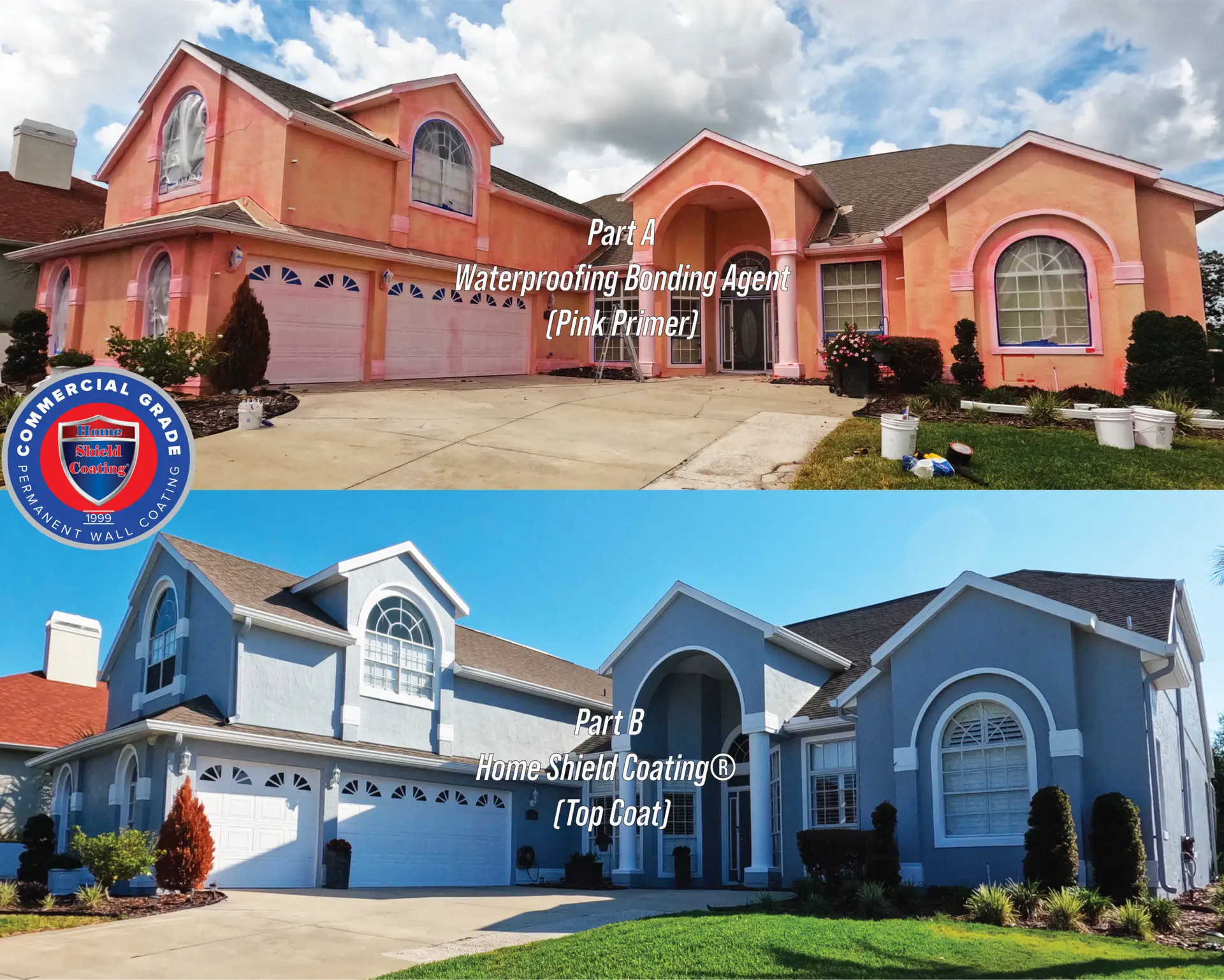
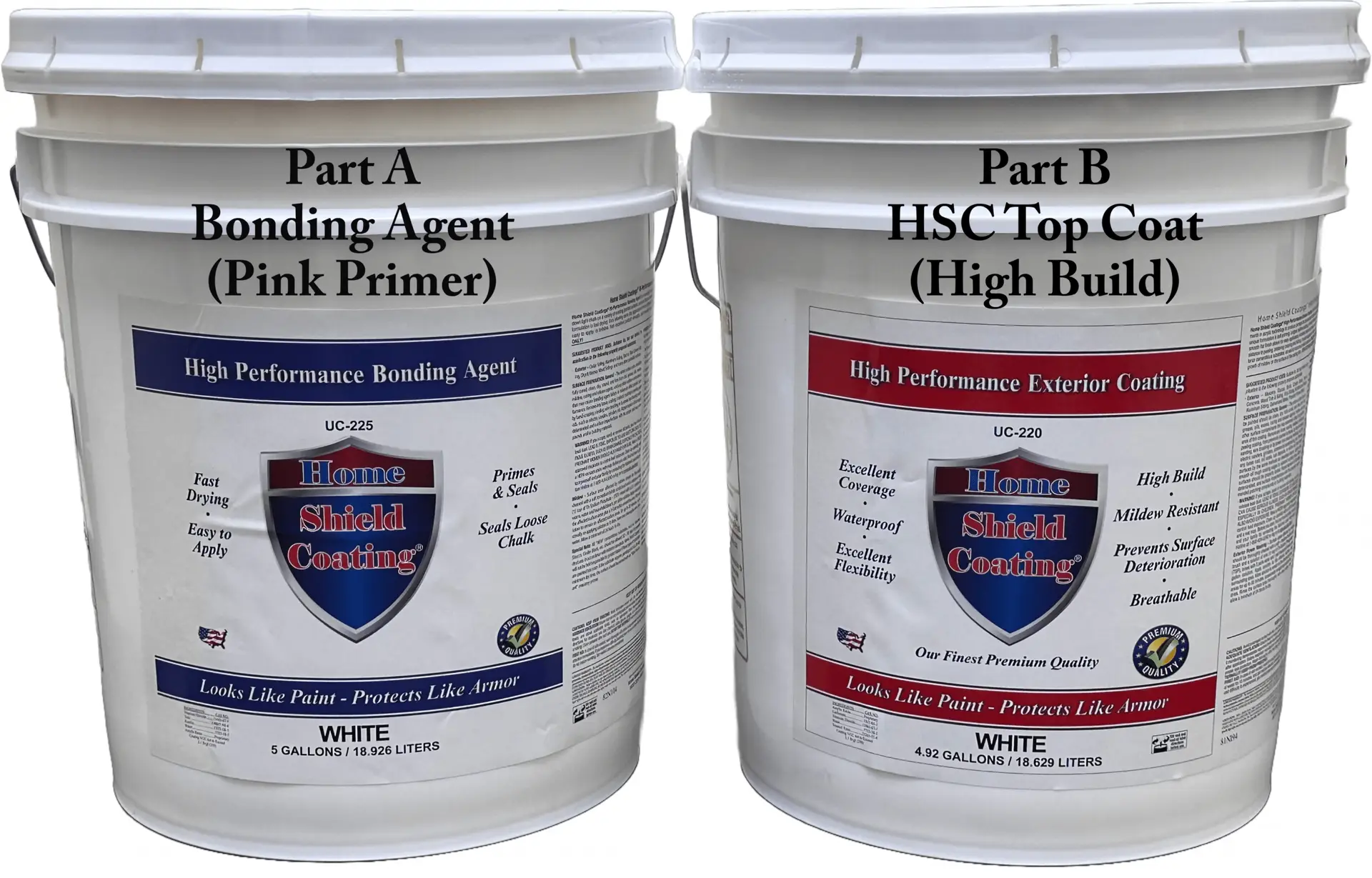
- Part A is the pink waterproof bonding agent primer. We spray it onto the prepared surface so it can penetrate, seal, and create the tacky bond needed for the finish coats.
- Part B is the Home Shield Coating® topcoat. We spray two controlled coats in the homeowner’s selected color to build the flexible exterior membrane.
The completed system is designed to block liquid water from the outside while allowing vapor to escape. It is applied 12 to 17 times thicker than ordinary paint and is backed on qualifying residential projects by a transferable 30-year combined warranty, including 10 years of labor and material coverage followed by 20 years of material coverage.
Standard Elastomeric Paint Compared With Home Shield Coating®
| Feature | Standard Elastomeric Wall Paint | Home Shield Coating® |
|---|---|---|
| System | Product-specific primer plus finish coats | Part A bonding primer plus two Part B topcoats |
| Application | Brush, roller, or spray depending on product | Professionally sprayed with airless equipment |
| Moisture plan | Depends on the product’s perm rating and wall condition | Designed to block liquid water while allowing vapor to escape |
| Thickness | Varies by product and specification | 12 to 17 times thicker than ordinary paint |
| Warranty | Often product-specific and material-only | 30-year combined transferable warranty on qualifying residential projects |
| Primary goal | Longer-lasting masonry finish | A permanent alternative to the repaint cycle |
Neither system belongs over an unresolved leak. We inspect the walls, identify visible water-entry points, and explain the repairs required before coating begins.
Questions to Ask Before Choosing a Coating
- What dry-film thickness is included in the proposal, and how many gallons will the job require?
- What is the product’s vapor-permeability or perm rating?
- How will cracks larger than hairline be repaired?
- What primer or block filler will be used before the finish coats?
- How many coats are specified, and how much drying time is required between them?
- Does the warranty cover labor as well as material?
Frequently Asked Questions
Is elastomeric paint waterproof
It sheds liquid water well when it is applied to a properly prepared wall at the specified thickness. It does not repair failed flashing, leaking windows, bad gutters, open joints, or structural cracks.
Does elastomeric paint trap moisture in stucco
It can. The risk depends on the product’s perm rating, the moisture already in the wall, and whether water continues to enter from another source. A breathable coating and a dry, repaired wall are both important.
Can elastomeric paint go over existing paint
Usually, if the existing paint is sound, clean, compatible, and firmly bonded. Loose, chalky, or peeling material must be removed. A heavy elastomeric film can pull weak paint away from the wall.
How long does elastomeric paint last
On a sound, repaired wall with the right primer and full film thickness, a good elastomeric repaint typically lasts about 4 to 7 years, and manufacturers may warranty the material for up to 10. Poor preparation or an active water problem can shorten that dramatically.
Can elastomeric paint be applied by a homeowner
It can, but meeting the specified wet and dry film thickness takes more material and more coats than most homeowners expect. Thinning the product or stretching the coverage too far is a common DIY failure.
What is the difference between elastomeric paint and block filler
Block filler is a primer made to fill pores and pinholes in bare concrete block. Elastomeric paint is the weather-exposed finish. On bare block, the compatible filler or masonry primer comes first.
Get an Honest Assessment of Your Walls
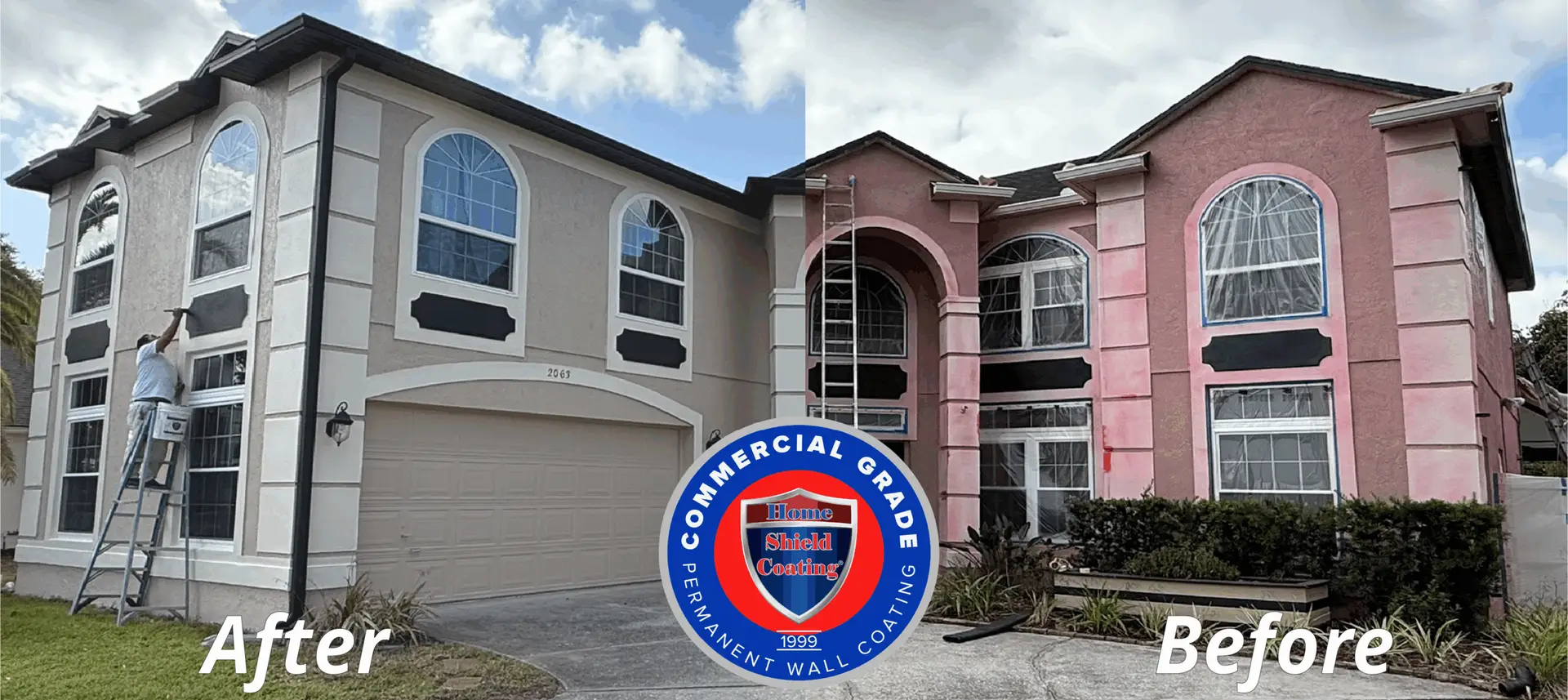
If your stucco or block walls are cracking, chalking, taking on water, or needing another repaint after only a few years, we will inspect the exterior and explain what we find. We can compare a standard paint job with a permanent Home Shield Coating® system so you can see the preparation, warranty, and long-term cost difference.
Sources
- SikaWall 4090 Elastomeric Coating product data sheet
- PAREX Elastomeric Finish product data sheet
- Northwest Wall and Ceiling Bureau Painting Stucco guidance
- HUD concrete masonry construction report
- Fixr Florida exterior painting cost guide
- Home Shield Coating® pricing guide
- Home Shield Coating® permanent exterior wall coating guide
- Home Shield Coating® stucco waterproofing guide
1250 container
1251 text Drop Cap
1252 container
1643 text Off On
1254 container
1255 text Columns
1256 container
1257 button Desktop
1258 button Tablet Portrait
1259 button Mobile Portrait
1260 pop up button (collapsed, settable) Columns, Value: Default, ID: elementor-control-default-c960, Secondary Actions: Expand
1261 menu
1262 1
1263 2
1264 3
1265 4
1266 5
1267 6
1268 7
1269 8
1270 9
1271 10
1272 (selected) Default
1644 text
1274 container
1275 text Columns Gap
1276 container
1277 button Desktop
1278 button Tablet Portrait
1279 button Mobile Portrait
1280 container
1281 text px px
1282 container
1283 slider 0
1284 stepper (settable) Columns Gap, ID: elementor-control-default-c963
1285 link Description: Need Help, Value: go.elementor.com/widget-text-editor, ID: elementor-panel__editor__help__link
508 text Hide Panel (⌘ + P)
509 container Description: Preview, ID: elementor-preview
510 container Description: Preview, ID: elementor-preview-iframe
511 AXWebArea Elastomeric Paint for Stucco and Block Walls, URL: homeshieldcoating.com/?p=36030&elementor-preview=36030&ver=1791918030
512 container the7-body
513 container page
514 link Description: Skip to content, Value: homeshieldcoating.com/?p=36030&elementor-preview=36030&ver=1791918030#content
515 container
516 container
517 content list top-menu
518 link Description: HOME, Value: homeshieldcoating.com/
519 link Description: CONTACT US PAGE, Value: homeshieldcoating.com/contact/
520 link Description: FINANCING AVAILABLE, Value: homeshieldcoating.com/financing/
521 link Description: JOIN OUR TEAM!, Value: homeshieldcoating.com/careers-employment/
522 text Top Bar Menu
523 text Home Shield Coating®
524 text The Premier Permanent Coatings Company!
525 link Description: Home Shield Coating®, Value: homeshieldcoating.com/
526 link Description: Call Us! (800) 330-9651, Value: tel:800-330-9651
527 link Description: Schedule Estimate Free Estimates, Value: homeshieldcoating.com/free-estimate
528 content list primary-menu
529 link Description: About, Value: homeshieldcoating.com/about/
530 link (collapsed) Description: Products, Value: homeshieldcoating.com/?p=36030&elementor-preview=36030&ver=1791918030#, Secondary Actions: Expand
531 link Description: Reviews, Value: homeshieldcoating.com/actual-customer-reviews/
532 link Description: Before & After, Value: homeshieldcoating.com/before-after-photos/
533 link Description: Pricing, Value: homeshieldcoating.com/pricing/
534 link (collapsed) Description: Locations, Value: homeshieldcoating.com/?p=36030&elementor-preview=36030&ver=1791918030#, Secondary Actions: Expand
535 link Description: Blog, Value: homeshieldcoating.com/blog/
536 link (collapsed) Description: Contact, Value: homeshieldcoating.com/?p=36030&elementor-preview=36030&ver=1791918030#, Secondary Actions: Expand
1645 container
1646 heading Elastomeric Paint for Stucco and Block Walls, Value: 1
1647 text Elastomeric Paint for Stucco and Block Walls
1648 content list
1649 text October 13, 2026
1650 content list
1651 button Share on facebook
1652 button Share on twitter
1653 button Share on linkedin
1654 button Share on pinterest
1655 container
1656 container
1657 container
1658 container
1659 container Elastomeric paint guide sections
1660 text Jump to a section:
1661 table
1662 row
1663 cell
1664 link Description: What it is, Value: homeshieldcoating.com/?p=36030&elementor-preview=36030&ver=1791918030#what-elastomeric-paint-is
1665 cell
1666 link Description: Where it works, Value: homeshieldcoating.com/?p=36030&elementor-preview=36030&ver=1791918030#where-elastomeric-paint-works-best
1667 cell
1668 link Description: Moisture, Value: homeshieldcoating.com/?p=36030&elementor-preview=36030&ver=1791918030#why-elastomeric-paint-can-trap-moisture
1669 row
1670 cell
1671 link Description: Cost and lifespan, Value: homeshieldcoating.com/?p=36030&elementor-preview=36030&ver=1791918030#cost-and-expected-service-life
1672 cell
1673 link Description: Home Shield Coating®, Value: homeshieldcoating.com/?p=36030&elementor-preview=36030&ver=1791918030#how-home-shield-coating-is-different
1674 cell
1675 link Description: FAQ, Value: homeshieldcoating.com/?p=36030&elementor-preview=36030&ver=1791918030#frequently-asked-questions
1676 text Quick answer
1677 text Elastomeric paint can be a good choice for stucco, concrete block, and other masonry walls, but it is not a shortcut around repairs. It performs best when the wall is dry, sound, properly flashed, and prepared to the coating manufacturer’s specifications. Put it over an active leak or damp masonry, and the same thick film that blocks rain can blister or peel as trapped moisture pushes outward. Homeowners often hear “use elastomeric” as a catch-all answer for cracked stucco or porous block. Sometimes that advice is right. Other times it hides the real problem for a few seasons and leaves the homeowner with sheets of peeling coating. The difference comes down to the wall, the water source, the primer, the finished film thickness, and the crew applying it.
1678 image Florida stucco home with Home Shield Coating® Part A primer and finished Part B topcoat
1679 text Part A bonding primer and the finished Part B topcoat on a Florida stucco home.
1680 heading What Elastomeric Paint Is, Value: 2, ID: what-elastomeric-paint-is
1681 text What Elastomeric Paint Is
1682 text Elastomeric means elastic. An elastomeric wall paint is a high-build acrylic coating made to stretch and recover as stucco or masonry moves. That extra thickness helps it span small surface cracks that ordinary exterior paint would simply copy. The exact numbers vary by product, so the product data sheet should control every job. As a category, elastomeric wall coatings usually share four traits:
1683 content list
1684 container
1685 AXListMarker •
1686 text More solids remain on the wall. Many elastomerics contain roughly 45 to 60 percent solids by volume.
1687 container
1688 AXListMarker •
1689 text They build a much thicker film. Many systems are specified around 10 to 20 dry mils per coat, while ordinary exterior paint is much thinner.
1690 container
1691 AXListMarker •
1692 text They stretch. Depending on the formulation, elongation may range from about 150 percent to several hundred percent.
1693 container
1694 AXListMarker •
1695 text They cover less area per gallon. A full-thickness coat may cover only about 60 to 100 square feet per gallon, compared with several hundred square feet for conventional paint.
1696 heading Elastomeric Paint Compared With Acrylic Exterior Paint, Value: 3
1697 text Elastomeric Paint Compared With Acrylic Exterior Paint
1698 table
1699 row
1700 cell
1701 text Feature
1702 cell
1703 text Regular Acrylic Exterior Paint
1704 cell
1705 text Elastomeric Wall Paint
1706 row
1707 cell
1708 text Film build
1709 cell
1710 text Thin maintenance finish
1711 cell
1712 text High-build protective film
1713 row
1714 cell
1715 text Movement
1716 cell
1717 text Limited stretch
1718 cell
1719 text Designed to stretch and recover
1720 row
1721 cell
1722 text Hairline cracks
1723 cell
1724 text Usually telegraphs the crack
1725 cell
1726 text Can bridge small, nonstructural cracks
1727 row
1728 cell
1729 text Coverage
1730 cell
1731 text Often several hundred sq ft per gallon
1732 cell
1733 text Often about 60 to 100 sq ft per gallon at full build
1734 row
1735 cell
1736 text Vapor movement
1737 cell
1738 text Usually more open
1739 cell
1740 text Varies widely; check the perm rating
1741 row
1742 cell
1743 text Application
1744 cell
1745 text Commonly one or two finish coats
1746 cell
1747 text Specified primer and multiple full-thickness coats may be required
1748 text These are planning comparisons, not universal specifications. Some modern elastomeric coatings are quite vapor permeable, while others form a much tighter film. Always compare the current product data sheets.
1749 heading Where Elastomeric Paint Works Best, Value: 2, ID: where-elastomeric-paint-works-best
1750 text Where Elastomeric Paint Works Best
1751 content list
1752 container
1753 AXListMarker •
1754 text Sound stucco with hairline cracking. A flexible film can span small surface cracks that would reappear through ordinary paint.
1755 container
1756 AXListMarker •
1757 text Above-grade concrete block walls. Block can be an excellent substrate once pinholes are filled and the wall is properly primed.
1758 container
1759 AXListMarker •
1760 text Poured and tilt-up concrete. Large masonry surfaces often benefit from a flexible, weather-resistant coating when the substrate is dry and stable.
1761 container
1762 AXListMarker •
1763 text Walls with working flashing and drainage. A coating performs best when roofs, windows, gutters, kick-out flashing, and wall drainage are already directing water away from the building.
1764 heading Bare Block Needs Block Filler, Value: 3
1765 text Bare Block Needs Block Filler
1766 text Unpainted concrete block is full of pores and pinholes. Before the finish coats go on, the wall normally needs a compatible block filler or masonry primer. The filler closes the surface so the elastomeric coating can form a continuous film instead of bridging thousands of tiny voids. The spread rate and cure time should come from the filler manufacturer’s data sheet.
1767 heading Why Elastomeric Paint Can Trap Moisture, Value: 2, ID: why-elastomeric-paint-can-trap-moisture
1768 text Why Elastomeric Paint Can Trap Moisture
1769 text It can happen, but it is not true of every product. Vapor permeability differs widely among elastomeric coatings. The risk rises when a low-perm product is installed over a damp wall or when water keeps entering through a window, roof-to-wall connection, failed sealant joint, overflowing gutter, or plumbing leak. The Northwest Wall and Ceiling Bureau recommends breathable coatings for stucco and points to a perm rating of 7 or higher as a useful benchmark. That is why the perm rating matters just as much as elongation and film thickness. A coating should shed liquid water while still allowing water vapor to escape from the wall assembly.
1770 heading Warning signs include, Value: 3
1771 text Warning signs include
1772 content list
1773 container
1774 AXListMarker •
1775 text Bubbles or blisters, especially on walls heated by afternoon sun
1776 container
1777 AXListMarker •
1778 text Coating that releases in sheets instead of small flakes
1779 container
1780 AXListMarker •
1781 text Mold or mildew appearing through or behind the finish
1782 container
1783 AXListMarker •
1784 text White efflorescence collecting around cracks or at the base of the wall
1785 text Before any coating goes on, the water source needs to be found and corrected. No wall coating, including Home Shield Coating®, should be used to cover an active leak.
1786 heading Why Elastomeric Paint Jobs Fail, Value: 2, ID: why-elastomeric-paint-jobs-fail
1787 text Why Elastomeric Paint Jobs Fail
1788 text The most common failures are installation failures. A high-build product has to be applied at the specified thickness, over the right primer, within the correct weather window. Cutting the material or rushing the job changes the coating the manufacturer tested.
1789 content list
1790 container
1791 AXListMarker •
1792 text The product is thinned. Adding water makes the coating easier to spray or roll but reduces the dry film left on the wall.
1793 container
1794 AXListMarker •
1795 text Too little material is used. A large wall area covered with a surprisingly small number of gallons is a warning sign.
1796 container
1797 AXListMarker •
1798 text One heavy coat replaces the specified system. Heavy application can sag, run, skin over, or cure unevenly. Many systems require two full coats.
1799 container
1800 AXListMarker •
1801 text Crack repairs are skipped. Elastomeric paint can bridge hairline cracks. It cannot repair structural movement, loose stucco, or open joints.
1802 container
1803 AXListMarker •
1804 text Primer or block filler is omitted. A finish coat cannot make up for a weak, chalky, or porous surface.
1805 container
1806 AXListMarker •
1807 text A damp wall is coated. Moisture trapped behind a dense film can create pressure that lifts the coating.
1808 text A useful question for any contractor
1809 text Ask what dry-film thickness the price includes and how many gallons the wall area requires. A clear answer should match the product data sheet and the square footage.
1810 heading Cost and Expected Service Life, Value: 2, ID: cost-and-expected-service-life
1811 text Cost and Expected Service Life
1812 text Elastomeric paint costs more than standard acrylic paint because each gallon covers less area and the wall often needs extra repair, primer, and finish coats. Published Florida cost guides commonly place elastomeric material around $30 to $60 per gallon, but product grade and contractor pricing vary. At full film build, the coating may use roughly three to five times as many gallons as ordinary paint. As a planning range, expect to pay a premium over a standard acrylic repaint rather than a multiple of it. Our 2026 pricing guide lists elastomeric on Florida stucco at about $5.00 to $6.50 per square foot versus $4.75 to $6.00 for premium acrylic latex. Most of that premium is material and primer, because each gallon covers far less wall and the primer step is not optional. Manufacturers often cite 10-year material warranties, but in Florida sun and humidity we typically see over-the-counter elastomeric repaints needed again in about 5 to 7 years, and sooner on exposed walls. Even the longer numbers assume the wall was repaired, the correct primer was used, and the coating reached its specified film thickness.
1813 heading How Home Shield Coating® Is Different, Value: 2, ID: how-home-shield-coating-is-different
1814 text How Home Shield Coating® Is Different
1815 text Home Shield Coating® is not a single pail of conventional elastomeric paint. It is a two-part coating system installed in three sprayed coats. Our crews use professional airless equipment rather than rolling the finish.
1816 content list
1817 container
1818 AXListMarker 1.
1819 text Part A is the pink waterproof bonding agent primer. We spray it onto the prepared surface so it can penetrate, seal, and create the tacky bond needed for the finish coats.
1820 container
1821 AXListMarker 2.
1822 text Part B is the Home Shield Coating® topcoat. We spray two controlled coats in the homeowner’s selected color to build the flexible exterior membrane.
1823 text The completed system is designed to block liquid water from the outside while allowing vapor to escape. It is applied 12 to 17 times thicker than ordinary paint and is backed on qualifying residential projects by a transferable 30-year combined warranty, including 10 years of labor and material coverage followed by 20 years of material coverage.
1824 image Home Shield Coating® Part A bonding primer and Part B high-build topcoat containers
1825 text The Home Shield Coating® system uses Part A bonding primer and the Part B high-build topcoat.
1826 heading Standard Elastomeric Paint Compared With Home Shield Coating®, Value: 3
1827 text Standard Elastomeric Paint Compared With Home Shield Coating®
1828 table
1829 row
1830 cell
1831 text Feature
1832 cell
1833 text Standard Elastomeric Wall Paint
1834 cell
1835 text Home Shield Coating®
1836 row
1837 cell
1838 text System
1839 cell
1840 text Product-specific primer plus finish coats
1841 cell
1842 text Part A bonding primer plus two Part B topcoats
1843 row
1844 cell
1845 text Application
1846 cell
1847 text Brush, roller, or spray depending on product
1848 cell
1849 text Professionally sprayed with airless equipment
1850 row
1851 cell
1852 text Moisture plan
1853 cell
1854 text Depends on the product’s perm rating and wall condition
1855 cell
1856 text Designed to block liquid water while allowing vapor to escape
1857 row
1858 cell
1859 text Thickness
1860 cell
1861 text Varies by product and specification
1862 cell
1863 text 12 to 17 times thicker than ordinary paint
1864 row
1865 cell
1866 text Warranty
1867 cell
1868 text Often product-specific and material-only
1869 cell
1870 text 30-year combined transferable warranty on qualifying residential projects
1871 row
1872 cell
1873 text Primary goal
1874 cell
1875 text Longer-lasting masonry finish
1876 cell
1877 text A permanent alternative to the repaint cycle
1878 text Neither system belongs over an unresolved leak. We inspect the walls, identify visible water-entry points, and explain the repairs required before coating begins.
1879 heading Questions to Ask Before Choosing a Coating, Value: 2, ID: questions-to-ask-before-choosing-a-coating
1880 text Questions to Ask Before Choosing a Coating
1881 content list
1882 container
1883 AXListMarker 1.
1884 text What dry-film thickness is included in the proposal, and how many gallons will the job require?
1885 container
1886 AXListMarker 2.
1887 text What is the product’s vapor-permeability or perm rating?
1888 container
1889 AXListMarker 3.
1890 text How will cracks larger than hairline be repaired?
1891 container
1892 AXListMarker 4.
1893 text What primer or block filler will be used before the finish coats?
1894 container
1895 AXListMarker 5.
1896 text How many coats are specified, and how much drying time is required between them?
1897 container
1898 AXListMarker 6.
1899 text Does the warranty cover labor as well as material?
1900 heading Frequently Asked Questions, Value: 2, ID: frequently-asked-questions
1901 text Frequently Asked Questions
1902 heading Is elastomeric paint waterproof, Value: 3
1903 text Is elastomeric paint waterproof
1904 text It sheds liquid water well when it is applied to a properly prepared wall at the specified thickness. It does not repair failed flashing, leaking windows, bad gutters, open joints, or structural cracks.
1905 heading Does elastomeric paint trap moisture in stucco, Value: 3
1906 text Does elastomeric paint trap moisture in stucco
1907 text It can. The risk depends on the product’s perm rating, the moisture already in the wall, and whether water continues to enter from another source. A breathable coating and a dry, repaired wall are both important.
1908 heading Can elastomeric paint go over existing paint, Value: 3
1909 text Can elastomeric paint go over existing paint
1910 text Usually, if the existing paint is sound, clean, compatible, and firmly bonded. Loose, chalky, or peeling material must be removed. A heavy elastomeric film can pull weak paint away from the wall.
1911 heading How long does elastomeric paint last, Value: 3
1912 text How long does elastomeric paint last
1913 text On a sound, repaired wall with the right primer and full film thickness, a good elastomeric repaint typically lasts about 4 to 7 years, and manufacturers may warranty the material for up to 10. Poor preparation or an active water problem can shorten that dramatically.
1914 heading Can elastomeric paint be applied by a homeowner, Value: 3
1915 text Can elastomeric paint be applied by a homeowner
1916 text It can, but meeting the specified wet and dry film thickness takes more material and more coats than most homeowners expect. Thinning the product or stretching the coverage too far is a common DIY failure.
1917 heading What is the difference between elastomeric paint and block filler, Value: 3
1918 text What is the difference between elastomeric paint and block filler
1919 text Block filler is a primer made to fill pores and pinholes in bare concrete block. Elastomeric paint is the weather-exposed finish. On bare block, the compatible filler or masonry primer comes first.
1920 heading Get an Honest Assessment of Your Walls, Value: 2, ID: get-an-honest-assessment-of-your-walls
1921 text Get an Honest Assessment of Your Walls
1922 text If your stucco or block walls are cracking, chalking, taking on water, or needing another repaint after only a few years, we will inspect the exterior and explain what we find. We can compare a standard paint job with a permanent Home Shield Coating® system so you can see the preparation, warranty, and long-term cost difference.
1923 image Before and after Home Shield Coating® stucco project in Oviedo Florida
1924 text A Home Shield Coating® stucco project in Oviedo, Florida, shown before and after the permanent coating system.
1925 link Description: Request a free estimate, Value: homeshieldcoating.com/free-estimate/
1926 heading Sources, Value: 2, ID: sources
1927 text Sources
1928 content list
1929 container
1930 AXListMarker •
1931 link Description: SikaWall 4090 Elastomeric Coating product data sheet, Value: usa.sika.com/dam/dms/us01/k/sikawall-4090-elastomericcoating.pdf
1932 container
1933 AXListMarker •
1934 link Description: PAREX Elastomeric Finish product data sheet, Value: usa.sika.com/dam/dms/us01/t/parex-elastomericfinish.pdf
1935 container
1936 AXListMarker •
1937 link Description: Northwest Wall and Ceiling Bureau Painting Stucco guidance, Value: images.greenbuildingadvisor.com/app/uploads/2021/12/15153017/NWCB-document-Painting-Stucco.pdf
1938 container
1939 AXListMarker •
1940 link Description: HUD concrete masonry construction report, Value: huduser.gov/portal/publications/pdf/conrpt1-2.pdf
1941 container
1942 AXListMarker •
1943 link Description: Fixr Florida exterior painting cost guide, Value: fixr.com/costs/paint-house-exterior-florida
1944 container
1945 AXListMarker •
1946 link Description: Home Shield Coating® pricing guide, Value: homeshieldcoating.com/pricing/
1947 container
1948 AXListMarker •
1949 link Description: Home Shield Coating® permanent exterior wall coating guide, Value: homeshieldcoating.com/the-premier-coating-company/
1950 container
1951 AXListMarker •
1952 link Description: Home Shield Coating® stucco waterproofing guide, Value: homeshieldcoating.com/permanent-exterior-coating/waterproofing-stucco-exterior/
1953 container
1954 container
1955 heading CONNECT WITH US, Value: 2
1956 text CONNECT WITH US
1957 content list
1958 link Description: Facebook, Value: facebook.com/HomeShieldCoating
1959 link Description: Youtube, Value: youtube.com/channel/UC3sKvORkYKV_CrKz8M9pMhA
1960 link Description: Twitter, Value: twitter.com/HomeShieldCoat
1961 link Description: Pinterest, Value: pinterest.com/miked0201/
1962 link Description: Instagram, Value: instagram.com/homeshieldcoating/
1963 container
1964 link Description: Free Estimates, Value: homeshieldcoating.com/free-estimate/
1965 container Description: Add new layout element, ID: elementor-add-new-section
1966 button Add New Section
1967 button Add Template
1968 text Drag widget here
861 container
862 text Home Shield Coating®
863 container
864 link Description: 1000 Brown St. Unit 110 Wauconda, IL 60084, Value: homeshieldcoating.com/home-shield-coating-of-illinois/
865 link Description: 925 Elm Grove Rd. Suite 302 Elm Grove, WI 53122, Value: homeshieldcoating.com/home-shield-coating-of-wisconsin/
866 link Description: 7901 Kingspointe Pkwy. Ste 20 Orlando, FL 32819, Value: homeshieldcoating.com/home-shield-coating-of-florida/
867 container
868 text © 2026 Home Shield Coating®. All Rights Reserved.
869 link Description: Privacy Policy, Value: homeshieldcoating.com/privacy-policy/
870 text |
871 link Description: Sitemap, Value: homeshieldcoating.com/sitemap/
872 text |
873 link Description: XML Sitemap, Value: homeshieldcoating.com/sitemap_index.xml
874 text desktop
875 container to5aP0Vie3KAVC2ieLVQFA
876 container Description: Chat widget, ID: tDBK_WI3FR7fZ8TNzuM7fr
877 AXWebArea about:blank
878 container
879 text 1
880 button Chat widget
881 text Hi We’re Here!
882 container Description: Chat widget, ID: t9foXc0k9Kr1X712rmd9kg
883 AXWebArea about:blank
884 button (collapsed) Description: Chat widget, ID: tawk-bubble-container, Secondary Actions: Expand
885 image Chat attention grabber
886 container Structure, ID: elementor-navigator
887 container elementor-navigator__inner
888 container elementor-navigator__header
889 button Description: Expand all elements, ID: elementor-navigator__toggle-all
890 heading Structure, Value: 2, ID: elementor-navigator__header__title
891 text Structure
892 button Description: Close structure, ID: elementor-navigator__close
1621 container
1622 text Show/hide inner elements Section
1623 container
1624 text Show/hide inner elements Column
1625 container
1626 text Text Editor
1627 container
1628 text Template
1629 container
1630 text Button
896 text Resize structure