
Rhino Shield Reviews, Warranty & Cost: Read This Before You Sign
Rhino Shield is a well-known ceramic exterior coating, but public court records, news investigations, state business registries, and hundreds of homeowner reviews provide compelling reasons to read the fine print first. In this deep dive, we look past the marketing hype to analyze actual data and government policies. We scrutinize bold claims like the “Rhino Shield 25-Year Warranty,” “Save 30% on Energy,” “Insulates Equal to R-6.89,” and their “Energy Star Rating.” Before you overpay for a product making such massive promises, we want to put the facts squarely in front of you so you can make an informed decision.
-
The Home Shield Difference: Home Shield Coating® features identical family ownership since 1999, a 30-year combined system warranty that explicitly includes a 10-year written labor guarantee, and an unblemished record of zero lawsuits in 25+ years.
How the Rhino Shield Business Model Actually Works
To understand what you are actually buying, you must separate three distinct entities that the sales pitch often blurs together: who owns the brand, who manufactures the coating, and who sells, installs, and services it on your home.
-
Brand Owner In May 2021, AmCoat Industries was acquired by private-equity firm One In A Row Ventures, LLC, and renamed AmCoat Industrial, LLC. According to PCI Magazine, dealer-network growth was the stated priority. Because the brand has been under private equity ownership for several years, its corporate strategy is optimized for rapid expansion and profit.
-
Manufacturer: AmCoat states publicly that it manufactures Rhino Shield in the USA. However, its corporate headquarters is a Class A office suite at 4100 Legendary Drive in Destin, Florida—a multi-tenant building shared with a mall-management office and a law firm. According to the Better Business Bureau (BBB), the corporate brand operates entirely out of this single suite, and business databases list AmCoat as having only 1 to 10 employees. Consumer warning sites and long-running homeowner forums frequently report that Rhino Shield is actually a private-label product manufactured by Nationwide Protective Coatings Manufacturers of Sarasota, Florida. Either way, the corporate entity behind the brand is an office-suite operation, not a massive chemical plant.
-
Who Handles Warranty Claims? Local Dealers and Installers Not AmCoat. The brand is sold exclusively through independent, local dealer-contractors who market, apply, and legally warranty the coating in their respective territories. You cannot buy Rhino Shield at Home Depot, Lowe’s, or Sherwin-Williams. A Sixth Circuit Court of Appeals opinion confirms this structure, describing Rhino Shield as both a business name and a coating material distributed through independent dealers. Hunter v. Rhino Shield, No. 21-3748
Why the Three-Layer Business Model Matters to You
This three-layer structure—a private-equity-owned brand, sitting on top of a private-label product, sitting on top of a network of independent LLCs—is exactly why local dealer stability, reputation, and written warranty language matter above all else.
AmCoat sells its product into the dealer network and collects its revenue the moment the product ships. The local dealer is entirely responsible for everything that happens next: installation, callbacks, and warranty repairs. When a local dealer closes down—and state records show just how often that happens—there is no factory service team coming to save you. There is no service van traveling from AmCoat’s small office suite in Destin, Florida, to repair a home in, say, Milwaukee, Wisconsin. This structural disconnect is the root cause of the many Rhino Shield Complaints detailed below.
Rhino Shield Paint Reviews: What Real Customers Are Saying
If you are researching Rhino Shield reviews before signing a contract, you should know what the public record actually shows. Across PissedConsumer, Google, Yelp, the BBB, and court filings, we counted 335 417 documented complaints and lawsuit references tied to Rhino Shield dealers (updated August 2026) — including 126 128 PissedConsumer reports, 119 Google reviews, 43 105 Negative Yelp reviews, 36 54 BBB complaints, and 11 lawsuit references.
The recurring themes in negative Rhino Shield paint reviews are remarkably consistent:
- Peeling, blistering, and fading within the first few years
- Warranty claims denied or routed back to the original dealer, who is often no longer in business
- High-pressure sales and quotes that come in at three to five times a standard paint job in some markets
- Dealer turnover — we identified nine dissolved or inactive Rhino Shield dealer entities in state business registries
The full Public Record Counter, lawsuit links, and dealer-turnover data are documented further down this page. We update the count as new filings and reviews surface.
The Fine Print: Rhino Shield's 25-Year Warranty Only Covers Labor For 1 Year!
For years, Rhino Shield has advertised a massive 25-year warranty. However, consumer reports reveal that local dealers frequently bury a 1-year labor limitation on the back of the contract—where most buyers never look. It is only when homeowners experience a major product failure a few years down the road, just like the homeowner in the video above, that they discover the trap. As this homeowner states, he feels completely robbed and left with zero recourse. This is exactly why it is vital to read every single line on both the front and back of a contract before signing.
While Rhino Shield heavily markets a 25-year guarantee with a written, transferable, non-prorated warranty, its official Buyer’s Guide admits that the actual labor protection is completely open-ended and left up to the local dealer:
“Each Rhino Shield Dealer provides a labor warranty that can range from 1-5 years.”
The corporate FAQ goes even further, stating:
“Rhino Shield Corporate [AmCoat] is not responsible for labor.”
Read that again: a heavily advertised “25-year warranty” where the actual labor portion can expire at the end of month twelve. A 2025 review summed up this exact pattern in a homeowner’s own words: “The advertised 25-year warranty is effectively a 1-year labor warranty. Rhino Shield dealers do not honor warranties from other dealerships”(PissedConsumer, March 2025).
Ultimately, a 25-year material warranty paired with a mere 1-year labor warranty is, functionally, a one-year warranty for anything that requires a crew to fix—which is almost everything.
Reputation & Accountability Matters
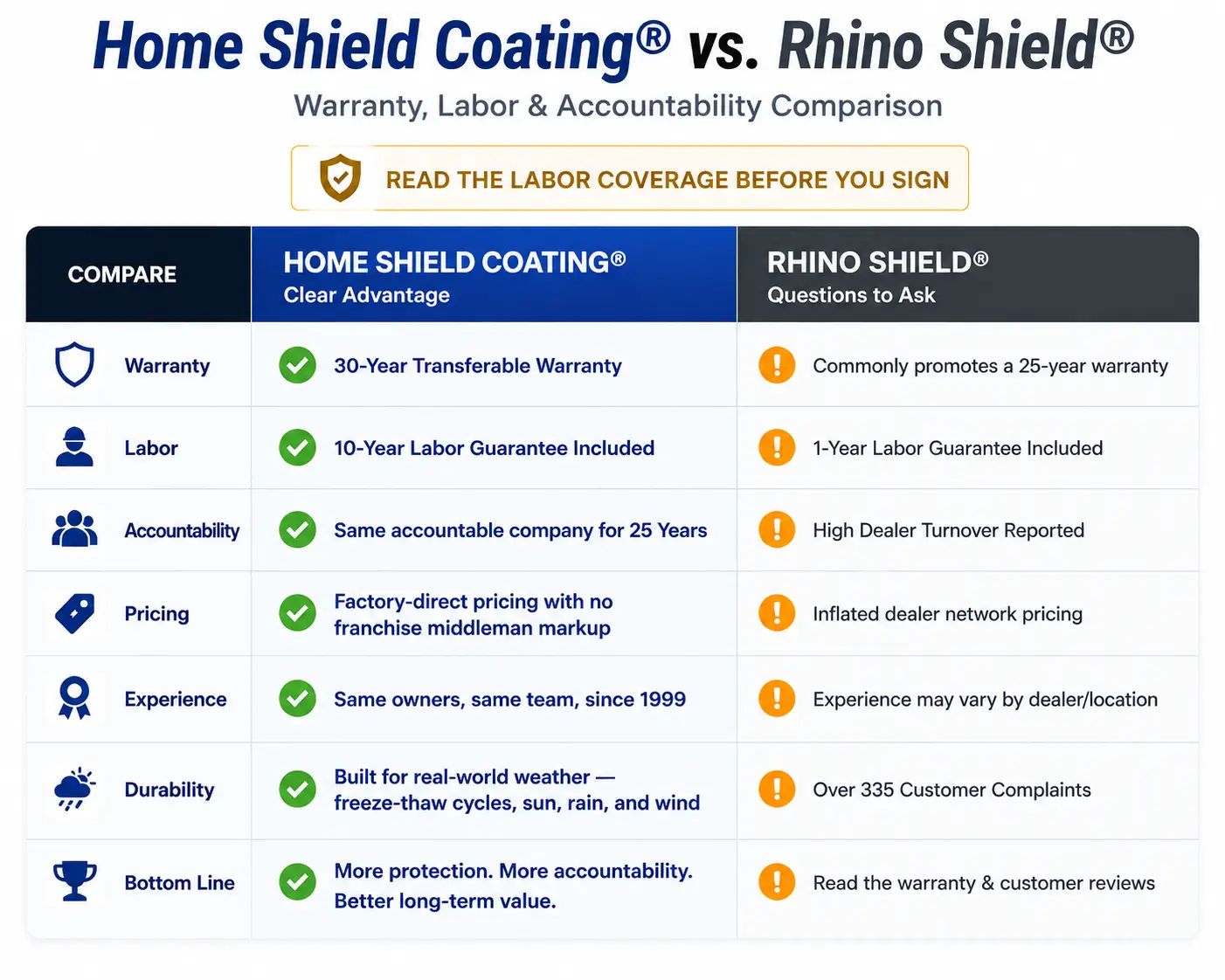
When you invest in a permanent exterior wall coating, you aren’t just buying a product in a bucket—you are investing in the company that stands behind it. The comparison chart highlights three critical pillars that set Home Shield Coating® apart from the independent franchise dealer network model:
1. Total Accountability (No Middleman Realities)
With standard franchise coatings, your contract is split across a confusing multi-layered web: the brand owner, the local dealer, and the chemical manufacturer. If the product fails, the finger-pointing begins.
The Home Shield Coating Difference: We provide a single point of contact. We are one accountable company standing entirely behind the job. There is no middleman markup, no independent franchise network to absorb, and no corporate parent to deflect blame. If you ever have a question or need service, you call us directly.
2. Proven Experience Since 1999
A warranty is only as reliable as the track record of the company issuing it. Many local franchise dealers vanish within a few years, leaving their long-term warranties completely worthless.
The Home Shield Coating Difference: We have been operating under the same ownership and the same core team since 1999. We have spent nearly three decades earning our reputation directly with homeowners in our communities. You cannot buy a good reputation or decades of local expertise—both must be earned over time.
3. Commercial-Grade Weather Durability
Many residential exterior coatings are simply rebranded thick paints that struggle to adapt to extreme environmental changes.
The Home Shield Coating Difference: Our system is a commercial-grade, flexible hybrid formulation originally engineered for industrial and mid-rise buildings. It is specifically built to handle intense weather extremes—from punishing freeze-thaw cycles and heavy rain to blistering sun and wind. Because it bonds securely to your siding while remaining breathable, it prevents the trapped-moisture peeling that compromises traditional coatings.
The Bottom Line: Don’t stop at the headline warranty. True long-term value requires a superior commercial-grade product applied by an experienced, fully accountable team that will actually be here to answer the phone twenty years from now.
Same Company. Same Team. Same Warranty — Since 1999.
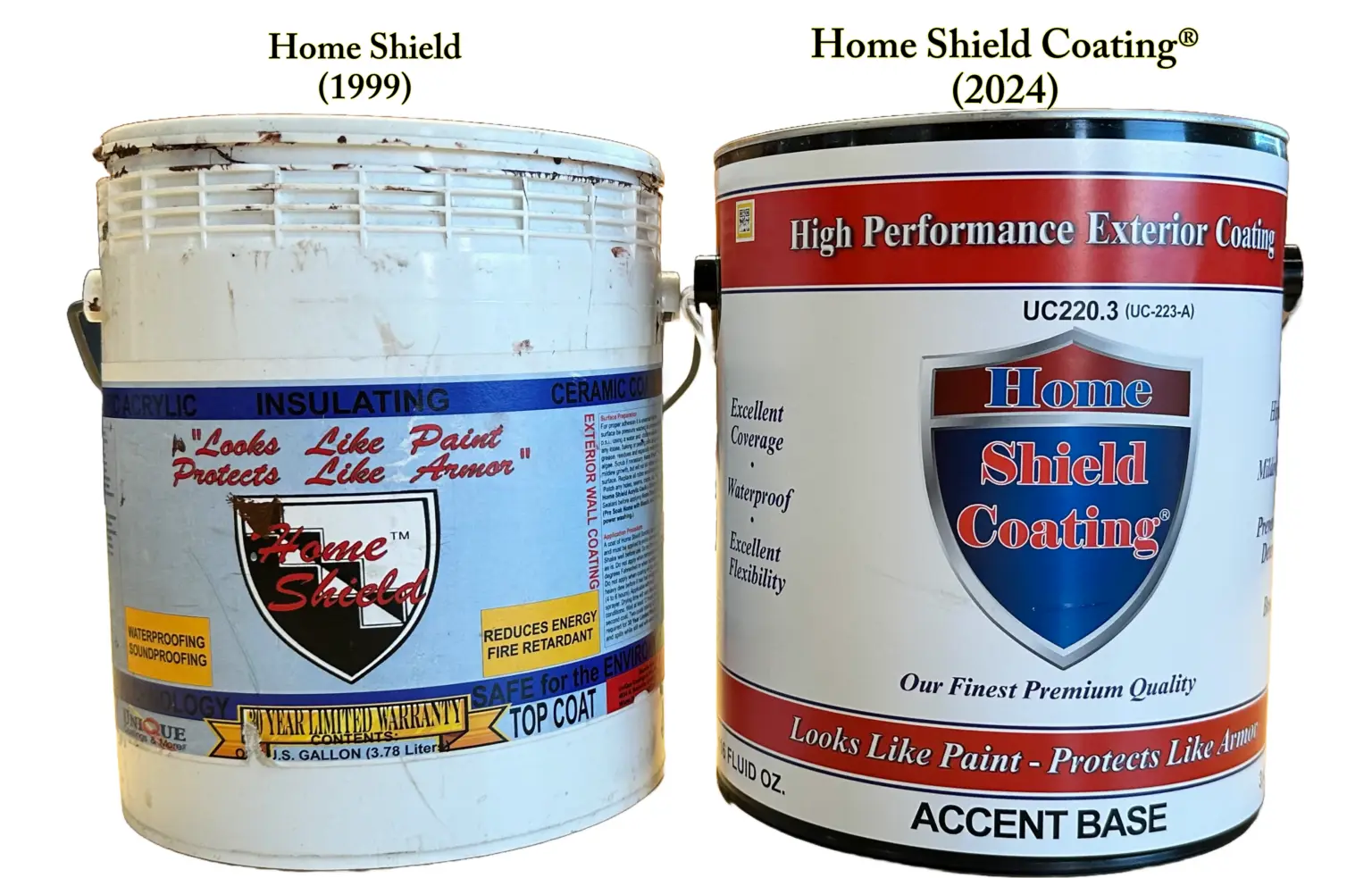
Proudly Serving ● Illinois ● Wisconsin ● Florida
The Home Shield Coating® system is backed by a 30-year combined warranty: 10 years of full labor and material coverage, followed by 20 years of material protection (Home Shield Coating Buyer’s Guide). That is 10 times longer than Rhino Shield’s documented 1-year written labor warranty—and it comes directly from the same company that performs your installation.
With Home Shield Coating, there is no one else to blame if a problem arises. You will never have to worry about a vanished local dealer or a corporate office giving you the runaround. Combining proven durability with a reputation for top-notch customer service since 1999, Home Shield Coating® stands as a premier permanent coating provider. Over nearly three decades in business, we have received exactly two formal complaints and zero lawsuits. In both of those rare instances, the homeowners were offered a complimentary resolution to redo portions of their homes as a courtesy, even though the issues were entirely unrelated to product failure.
Rhino Shield Lawsuits and Public-Record Findings

Smart homeowners search the terms “Rhino Shield lawsuit,” “Rhino Shield problems,” and “Rhino Shield complaints” before signing an agreement for good reason. Then they also get three quotes. They never fall victim to high-pressure, time-share-style sales tactics like “buy today or the price goes up tomorrow.”
Louisiana — the worst case: Between 2013 and 2017, nine Rhino Shield of Louisiana customers sued the company and its principal over failed coatings. Rather than work through those claims, the dealer voluntarily dissolved its LLC in 2015, mid-litigation. The amounts the homeowners sued for, and the legal fees incurred, have not been publicly disclosed. The “national presence” pitch was no help once the local LLC stopped existing. The same operator then launched a successor franchise called Rhino Shield Gulf South — he then turned around and sued his own insurance companies (RSUI Group and Landmark American), claiming they had “extracted” more than $115,000 from the franchise during settlement negotiations with the nine homeowners. A federal judge dismissed that bad-faith suit. The $115,000 is the only dollar figure in the public record — what the homeowners actually demanded, and what anyone paid in legal fees, was never disclosed and is almost certainly much higher. Rhino Shield dealers point to their ASTM test results and their 25-year warranty in the sales pitch. The public record, however, shows that when serious problems surface, the dealer entity itself can dissolve mid-litigation — as the Louisiana dealer did in 2015, leaving nine homeowners with active claims and no defendant on the docket. AmCoat corporate did not appear in the cited case record, and homeowners were left relying on a local dealer that was already facing significant legal and financial exposure.
Rhino Shield's Dealer Turnover

State Business Registries Show Significant Dealer Turnover
We pulled the official business registries in four states. Rhino Shield dealers open, run a few years, and dissolve — often while homeowners are still waiting on warranty help. In Wisconsin and Minnesota, there’s no business registered under “Rhino Shield” at all; dealers operated under generic shell names like “The Rhino Group” and “Wisconsin Coating Professionals.”
|
State |
Registered entity |
Status |
|
Florida |
Rhino Shield of South Florida LLC |
Dissolved 09/27/2024 |
|
Florida |
Rhino Shield of Central Florida, LLC |
Dissolved 09/24/2021 |
|
Florida |
Rhino Shield Gulf South, LLC |
Dissolved 09/06/2020 |
|
Louisiana |
Rhino Shield of Louisiana, LLC |
Dissolved 04/30/2015 (mid-litigation) |
|
Wisconsin |
The Rhino Group LLC |
Dissolved 10/24/2020 |
|
Wisconsin |
Rhino Exteriors of Wisconsin, LLC |
Dissolved 01/27/2020 |
|
Minnesota |
Rhino Exteriors LLC |
Lapsed 12/31/2017 |
Sources: FL Sunbiz, WI DFI, MN SOS, Legal Newsline.
Same operators, different states, then a rebrand. The same Rhino Shield of Jacksonville dealers appear across three of these states — as the registered agent of the dissolved Wisconsin and Minnesota entities and, per a homeowner complaint, the owner of the Jacksonville dealership. One March 2025 review describes the cross-state pattern: “Former Rhino Shield Jacksonville owners… operated in Milwaukee and Minnesota, leaving behind a trail of damaged homes before returning to Jacksonville, FL. Each new dealer has disclaimed responsibility for previous work, stating, ‘We are not the dealers who serviced your house, therefore, we are not obligated to honor the warranty.'” The same review alleges Rhino Shield Jacksonville was later sold and rebranded as Rhino Shield Florida (PissedConsumer, March 2025). Following the dissolution of the Minnesota and Wisconsin entities, the same operators are reportedly back in Florida selling a new product called Shark Coatings. The new Rhino Shield Florida dealer has been operating for just a couple of years.
When the same operators open, close, and reopen Rhino-branded companies across states and reportedly rebrand to bury the prior history a “transferable” warranty is only as durable as the entity behind it.
Rhino Shield Complaints Across Ten Markets
Rhino Shield Lawsuits & Complaints: A Running Public-Record Tally
Before you sign, do what smart homeowners do — look up the public record. These figures are compiled from court opinions, federal dockets, state business registries, and major consumer-complaint platforms.
Tracked by source
- 9 Louisiana homeowner suits (2013–2017): nine lawsuits filed by Rhino Shield of Louisiana customers; the franchise dissolved its LLC mid-litigation in 2015, leaving the nine homeowners on their own. The amounts the homeowners sued for and the legal fees incurred were never publicly disclosed. The franchise’s successor entity later sued its own insurers for more than $115,000 it claimed they extracted during settlement negotiations — a federal judge dismissed that bad-faith suit.
- BBB complaints across dealer profiles:
3654 complaints in the last 3 years across 8 active Rhino Shield dealer profiles — Pittsburgh PA (14), Indianapolis IN (12), New England / Pembroke MA (8), Columbus OH (6), Mid-South LA / Metairie (5), Jacksonville FL (4), Arizona / Chandler (3), and Lebanon OH (2) — with recurring warranty, peeling, and workmanship themes. Updated August 26, 2026 — up 18 complaints since June 2026. - Dissolved dealers across FL & WI: official state registries show at least 9 Rhino Shield / Rhino Exteriors dealer entities dissolved or inactive in Florida and Wisconsin — while the current Florida dealer has operated only a couple of years.
- PissedConsumer: a 1.4-out-of-5 rating across
126128 complaints, 95% of them negative, with recurring themes of fading, peeling, warranty denials, and dealers who can’t be reached. Updated August 26, 2026. - Negative Google reviews: 119 one-star reviews tallied directly from Rhino Shield dealer Google Business Profile listings nationwide — warranty denials, peeling, and unresolved punch-list issues are the most common themes.
- Negative Yelp reviews:
43105 one-star reviews across Rhino Shield dealer listings nationwide, with the same warranty-failure and peeling complaints surfacing market after market. Updated August 26, 2026 — up 62 negative reviews since June 2026. - Hunter v. Rhino Shield (Ohio): homeowners litigated about 10 years across 3 courts and recovered a refund of the contract price ($10,919) — affirmed by the U.S. Sixth Circuit Court of Appeals.
Home Shield Coating® is not affiliated with Rhino Shield®. Figures reflect publicly available court opinions, federal dockets, state business-registry records, and the PissedConsumer and BBB consumer-review platforms connected to Rhino Shield and related coating operations. Consumer reviews are individual allegations; a lawsuit is an allegation unless and until a court rules, and outcomes vary by case. Counts are updated periodically from the linked public sources. Always read your specific warranty and verify your local dealer before signing.
The Rhino Shield Paint Sales Pitch vs. the Reality

Rhino Shield’s One-Year Labor Warranty
According to the WKMG News 6 investigation cited above, responsibility for warranty claims falls on the local dealers, not corporate. These local dealers may no longer be in business. New dealers are not responsible for warranty claims made by previous dealers and are allowed to “start fresh,” often turning past issues into new revenue opportunities.
Unfortunately, this has happened in multiple markets across the country. For example, Wisconsin DFI records show the Rhino Shield operation in Milwaukee has cycled through three separate dealer LLCs, and Florida Sunbiz filings show the current Rhino Shield dealer in the Orlando market is the third registered entity to run that territory. Every time a dealer closes, a new LLC files paperwork to take its place — and the state business registries make that succession a matter of public record.
The single most misleading thing about Rhino Shield is the way the Rhino Shield warranty is marketed. Rhino Shield advertises a “25-year warranty,” but read the fine print and you’ll find the warranty splits into two very different pieces:
| Coverage | Rhino Shield | Home Shield Coating® |
|---|---|---|
| Materials warranty | Up to 25 years (manufacturer) | 10 years full coverage + 20 years product |
| Labor warranty | 1 year labor (dealer-dependent) | 10 years labor |
| Who honors it if your dealer closes? | Often nobody — claim dies with the dealer | Home Shield Coating® corporate |
| Combined coverage | 25-year combined warranty | 30-year combined warranty |
This is why Rhino Shield warranty claims show up so often in negative reviews. The materials may technically be “warrantied” for decades, but the labor that makes the warranty usable is only covered for one year, and it’s covered by the local dealer not by Rhino Shield corporate. We identified nine dissolved or inactive Rhino Shield dealer entities in state business registries. When a dealer closes, homeowners are typically left holding the bag.
Home Shield Coating® backs both materials and labor through corporate, so your warranty doesn’t disappear if a local installer moves on. That’s the difference between a marketing warranty and a warranty you can actually use.
Rhino Shield’s New Dealers Offer “Special Warranties”
New dealers often offer potential customers whatever warranty terms they need to hear to close the sale, but previous customers are still stuck with the standard 1-year labor warranty. The new Rhino Shield dealers typically blame issues and negative online reviews on the previous owners (dealers) and promise to make things right. The new dealer will not honor a previous dealer’s warranty. They may make repairs at a discounted price but have no obligation to repair a previous dealer’s warranty issue. The problem with this “new dealer good, old dealer bad” logic is that the new dealer and the previous three before him are all using the same product and business model.
Rhino Shield’s ASTM Testing
Rhino Shield dealers heavily promote third-party testing and ASTM test results as proof that their coating is a superior, long-lasting product. But when you compare that marketing message with the growing public record of complaints, warranty disputes, dealer problems, and questionable claims, homeowners have every reason to look beyond the laboratory results.
ASTM testing can be valuable. It can measure specific product characteristics under controlled conditions and provide useful technical information. But laboratory testing is not the same thing as decades of real-world performance.
A lab cannot reproduce years of intense sunlight, driving rain, humidity, freeze-thaw cycles, moisture intrusion, surface movement, workmanship problems, or improper preparation. It also cannot tell you whether the dealer who sells you the coating today will still be in business years from now to honor the warranty.
And that is where we believe Rhino Shield’s story deserves much closer scrutiny. As of August 2026, our research has identified 417 one-star reviews, negative reviews, complaints, and documented consumer disputes associated with Rhino Shield dealers across BBB, PissedConsumer, Google, Yelp, and court records.
Just one month earlier, that number was 335. When a company and its dealers continually point to laboratory testing as evidence of superior quality and long-term durability, yet the number of documented unhappy customers continues to climb, homeowners should be asking some difficult questions.
If the system is as proven as the marketing suggests, why does the public record tell such a different story? Why are homeowners reporting problems with peeling, cracking, fading, application, warranty service, and getting repairs completed?Why have some Rhino Shield dealers disappeared, changed ownership, or gone out of business while customers were still relying on long-term warranties?
And when questions have also been raised over the years about Rhino Shield’s 25 year warranty representations, R-value claims, and ENERGY STAR Rating related marketing, we believe homeowners are justified in scrutinizing every major claim including how much significance they should place on the testing results presented during the sales process.
Does the carefully presented laboratory test story match what homeowners are actually experiencing in the real world?
We believe that question matters far more than a stack of test reports. Home Shield Coating® also provides customers with product data sheets containing our applicable ASTM testing. But we do not ask homeowners to simply take laboratory results or our marketing claims on faith.
We can show customers homes we coated more than 20 and even 25 years ago.
Those homes have been exposed to decades of sun, rain, snow, humidity, freezing temperatures, temperature swings, and everything else Mother Nature can throw at an exterior coating. That is why we believe homeowners considering any so-called permanent coating should ask for more than laboratory results.
A laboratory can tell you how a coating performed during a controlled test. A house that still looks good 20 or 25 years later tells you how the product, preparation, installation, and company performed together. For a homeowner making a major long-term investment, we believe that is the test that matters most.
30% Energy-Savings Claims — What the FTC Says
Some wall-coating companies in the category have advertised that ceramic coatings can cut utility bills by 30% or more and perform like insulation. While these claims sound appealing, the Federal Trade Commission (FTC) has made it clear that such marketing is misleading and, in some cases, illegal.
FTC Action Against Wall Coatings: False R-Value Claims
The FTC has sued multiple wall coating and paint companies for making false claims regarding R-value and energy savings. Rhino Shield is not one of the companies mentioned in these lawsuits. The deceptive practices cited by the FTC include:
-
Exaggerating R-Value Ratings: Claiming thin exterior coatings were equal to R-19 insulation.
-
Overstating Energy Savings: Promising reductions in utility bills of 30% to 50%.
According to the FTC, the sued companies could not provide scientific proof for their claims. Independent FTC testing revealed that their coatings actually had R-values below 1, providing virtually no measurable insulation benefit.
Rhino Shield and the Energy Star Rating
The team at Energy Star Rating has made their official position clear, echoing previous statements by the FTC: the EPA does not label paints and coatings used on the inside of roof decks or attics as part of its insulation program. This is because paints and coatings for exterior walls do not meet the Federal Trade Commission’s (FTC) definition of home insulation. While Rhino Shield may hold an Energy Star rating for their roof coating product, the official guidelines are clear when it comes to wall coatings they simply don’t qualify as insulation.
The Cool Wall Effect: The Real Science Behind Coating Energy Savings
When looking into permanent exterior coatings, you’ll often see national franchise brands throw around terms like “insulation” or imply that a thick layer of paint can magically add “R-value” to your home. But let’s look at the actual physics. R-value measures a material’s ability to resist heat transferring through it, and a microscopic layer of topcoat—no matter how thick or packed with ceramic beads it claims to be it cannot structurally alter your walls’ built-in insulation.
However, that doesn’t mean a high-performance coating can’t help lower your power bill. It just does it through a completely different scientific principle: The Cool Wall Effect.
A landmark study by the U.S. Department of Energy’s Lawrence Berkeley National Laboratory revealed that sunlight-reflecting “cool” exterior walls can actually save as much or even more energy than cool roofs. While roofs get hit by more direct, vertical sunlight, walls represent a vastly larger surface area on your home and are typically much less insulated. The Berkeley Lab researchers discovered that by applying a high-performance, solar-reflective coating to exterior walls, homeowners in warm climates with pre 1980 homes can possibly achieve annual HVAC energy cost savings of 8.3%.
This dramatic drop in energy consumption relies on two distinct metrics that have nothing to do with traditional R-value insulation:
-
Solar Reflectance: The ability to bounce incoming solar radiation away before it ever penetrates your home’s exterior substrate. While standard, non-cool walls absorb the vast majority of the sun’s energy, a high-performance cool wall reflects 40% to 60% or more of that heat.
-
Thermal Emittance: The ability of a surface to efficiently release any ambient heat it does manage to catch, rather than storing it and allowing it to radiate inward through your walls long after the sun goes down.
According to the Department of Energy study, the absolute biggest winners of The Cool Wall Effect are pre-1980 homes. Because older building codes required far less wall insulation, the energy-saving benefits of a reflective coating on these structures are three to six times greater than on brand-new builds.
So, when a contractor tries to sell you an exterior coating based on a fake “insulating” marketing pitch, remember that true wall efficiency isn’t about trapping heat inside thick layers—it’s about preventing the sun from baking your home in the first place. The Cool Wall Effect is like wearing a white shirt instead of a black shirt on a hot, sunny summer day; it will certainly keep you cooler, but it won’t act as insulation, and you will probably still feel the heat. This is why, at Home Shield Coating, we do not make false claims about R-values or offer unrealistic 30% – 40% energy reduction guarantees.
The bottom line? While coatings can help reduce heat transfer in warm climates they do nothing to help properties in colder climates. Regardless of the cool wall effect no company should be claiming any measurable R-Value because that will vary significantly depending on the year build and the insulation you have to begin with. If you are buying a wall coating to act as insulation you are going to be disappointed to find out you will not see a 30 to 40% reduction in your utility bills as some companies claim.
How Much Does Rhino Shield Cost?
The most common question we get is “how much does Rhino Shield cost” — and the honest answer is: more than most homeowners expect. Based on Rhino Shield’s own 2024 Buyer’s Guide and our market research across Florida, Illinois, and Wisconsin, here is what Rhino Shield pricing typically looks like:
| Project | Rhino Shield Cost | Standard Latex Paint |
|---|---|---|
| Per square foot (national avg.) | $8.50 – $9.00 | $3.00 – $5.50 |
| Per square foot (Florida market) | $9.30 – $13.50 | $2.00 – $4.00 |
| Typical 3-bedroom home | $13,000 – $18,000 | $4,500 – $8,500 |
| Premium vs. standard paint | 3× to 5× higher | Baseline |
Why the wide range on Rhino Shield price? Final cost depends on home size, surface prep, substrate, location, and which dealer quotes you. The most expensive Rhino Shield cost per square foot figures we have documented come from the Florida market. We strongly recommend collecting three written quotes before signing anything.
Call 800-330-9651 or request a free side-by-side estimate!
When Might Rhino Shield Actually Work for You?
Despite the risks that can come with an independent dealer network, Rhino Shield may still be a reasonable option for some homeowners.
We don’t believe Rhino Shield is inherently a bad product, and we’re not chemists attempting to judge the formulation itself. Our concerns are primarily with the dealer model, warranty structure, pricing, and the amount of variation homeowners may experience from one territory to another.
There are Rhino Shield dealers that have operated successfully in their markets for many years. If you’re considering Rhino Shield, we believe the decision should come down to three things:
1. Is your local dealer established?
Find out how long the company actually performing your installation has been operating under its current ownership and business entity. A dealer with a long local track record may present considerably less risk than one that has recently opened or changed ownership.
2. Who is responsible if something goes wrong?
Read the warranty and contract carefully. Determine exactly what Rhino Shield covers as the manufacturer and what your local dealer is responsible for covering—including labor, repairs, service calls, and reapplication. Most importantly, get those commitments in writing.
3. Does the price make sense compared with your alternatives?
Rhino Shield can represent a substantial investment. Before signing, compare the quote not only with traditional painting, but also with other permanent coating systems. Look at the total installed price, warranty coverage, labor protection, company history, and who will actually be standing behind the project years from now.
If the local dealer has a strong history, the warranty responsibilities are clear, and you’re comfortable with the price, Rhino Shield may be worth considering.
That’s still a lot to verify.
For homeowners comparing permanent exterior coatings in Florida, Illinois, and Wisconsin, we recommend looking beyond the brand name and asking a more important question:
Who is actually installing the coating—and who will be there to honor the warranty 10, 15, or 20 years from now?
Why Savvy Buyers Should Compare Permanent Coating Systems
Because permanent architectural coatings can cost two to three times more than a standard paint job, you owe it to your property — and your checking account — to shop around. In Florida, we have seen quotes come in four to five times higher than a repaint.
Every permanent coating brand operates on a completely different business infrastructure. Some rely on private-equity brand managers and a revolving door of local subcontractors. Others rely on factory-direct teams with decades of continuous local ownership.
Before you sign a contract based solely on a massive headline warranty number, ask every company the exact same questions: Who is legally responsible for the labor in year seven? Who answers the phone if this specific application crew goes out of business?
Rhino Shield Paint vs. Home Shield Coating®
The only thing the two brands share is the word “Shield.”
Sources: Rhino Shield Buyer’s Guide, state business registries (FL, WI, LA, MN), Hunter v. Rhino Shield (Sixth Circuit), BBB, PissedConsumer, Google, Yelp. See Public Record Tally above for link
12 Questions to Ask Before You Sign
How long does Rhino Shield Paint cover labor?
How long have you been a Rhino Shield dealer?
Will Rhino Shield be used on the whole project or do you substitute?
What happened to the other Rhino Shield dealer?
Does Rhino Shield paint cover fading and discoloration?
Does it cover bubbling, peeling, chipping, cracking, and flaking?
Who pays for inspection and prep if warranty work is needed?
Who pays for labor after the first year?
What happens if the dealer goes out of business?
Will another Rhino Shield dealer or Amcoat honor my warranty?
Can you show me your Energy Star Certificate from the EPA?
Can you show me your R-Value Certificate from the FTC?
Can you put the 30% Energy Savings in writing?
The Bottom Line
Rhino Shield Paint and Rhino Shield spray-on bed liner are two completely different products and companies. Public court opinions, FTC enforcement actions, state registries, and news investigations show that brand name recognition does not automatically equal durability, reliability, and protection.
Home Shield Coating® has maintained the same local ownership since 1999. By using dedicated, in-house crews and offering a 30-year combined warranty, we provide a proven track record of reliability from a company that still actively services its customers. We’re not the biggest exterior coating company in the country—and honestly, we’re not trying to be. We’re the company that still stands behind the work we did decades ago.
Ready to compare your options? Call Home Shield Coating® for a free, no-obligation estimate. We’ll walk you through the coating system, the warranty, the pricing, and every critical question worth asking before you sign a permanent exterior coating contract. We will even advise you if a permanent wall coating is not the right choice for your property. Sometimes, a homeowner is truly better off with a simple wash and paint; either way, we always do what’s best for the customer, not our bank account. We also offer traditional exterior paint jobs. Our goal is to help as many customers as possible regardless of their budget.
About This Content
Author: Mike Diaz, CEO, Home Shield Coating®
I have spent over 25 years applying and inspecting permanent exterior coatings across Florida, Georgia, Indiana, Illinois, Michigan and Wisconsin, working hands-on with stucco, cedar siding, aluminum siding, asbestos siding, fiber cement, Dryvit, brick, and metal exteriors. Over the years, our team has come across several independent Rhino Shield dealers in different markets—some of whom we have even become friendly with. However, we have also witnessed what can happen when a local dealer enters a market, and what happens to their customers if that dealership closes or leaves. We have talked to multiple property owners who called our office asking for help after their local Rhino Shield dealer exited their market.
In fact, the brand confusion can get wild. We’ve had angry people yell and throw beer at our trade show staff, and others screaming and cursing us out on the phone, only to later say, “Sorry guys, we got you confused—we have the wrong ‘Shield’.”
Make sure you hire the right SHIELD the first time, so you don’t have to call us about a problem another company left behind.
Disclaimer: Home Shield Coating® is not affiliated with, endorsed by, sponsored by, or connected to Rhino Shield®, AmCoat Industries LLC, or any Rhino Shield dealer. Rhino Shield® is a registered trademark of AmCoat Industries LLC. References to Rhino Shield® are used only for lawful comparison, truthful experiential commentary, and consumer education. Consumer experiences, warranty terms, dealer coverage, and labor coverage vary by independent location and change over time. Consumers should review the current, written warranty and active dealer status directly from the provider before making a purchase decision.
Frequently Asked Questions
How much does Rhino Shield Cost in Florida?
The most expensive Rhino Shield quotes are coming out Florida with ranges from $9 to $14.50 per square foot. For a standard 2,000-square-foot home, homeowners can expect a quote between $18,000 and $29,000. Complex projects or homes requiring extensive structural prep work can reach up to $16 per square foot.
What is the catch with the Rhino Shield 25-year warranty?
While Rhino Shield heavily markets a 25-year warranty, its corporate terms only cover the coating materials. According to their official buyer’s guide, the essential labor and application warranty is set independently by local dealers and typically lasts only 1 to 5 years. If a local dealer goes out of business, corporate does not cover subsequent labor costs.
Does Rhino Shield Corporate honor a warranty if a local dealer goes out of business?
No, Rhino Shield Corporate states in its official terms that it is not responsible for installation labor. Public record consumer investigations have shown that if an independent local Rhino Shield dealership dissolves or changes ownership, the new local dealer is under no obligation to honor labor warranties provided by the previous entity.
Is permanent exterior ceramic coating worth the investment?
Yes, permanent wall coatings are highly cost-effective because they are up to 17 times thicker than standard exterior paint and eliminate the need to repaint every 3 to 5 years. However, when evaluating the investment, homeowners should look for providers offering extensive labor guarantees alongside material coverage—such as Home Shield Coating’s 10-year written labor protection.
Are there any Rhino Shield lawsuits or complaints on public record?
Yes. Public court records, state business registries, and consumer-review databases include multiple documented lawsuits, BBB complaints, and hundreds of negative consumer reviews against Rhino Shield and its independent local dealers. Because installation labor is governed by local franchise agreements, homeowner disputes often name the local dealer directly rather than the corporate brand. Property owners should search "Rhino Shield lawsuit" and their state's business registry before signing any contract.
What are the biggest problems homeowners report with Rhino Shield?
The most frequently reported problems are peeling and delamination within 5 to 7 years, labor warranty gaps once the local dealer's 1-year labor period expires, and difficulty reaching corporate for support when a local dealership dissolves or is sold. Because Rhino Shield is applied by independent local dealers, the quality of installation and the aftercare experience can vary widely by market.
What's the average cost of Rhino Shield natiowide?
Rhino Shield typically costs between $7.50 and $9.00 per square foot for a standard residential job, with complex projects reaching $14 per square foot. For a 2,000 sq. ft. home, the average installed price is $15,000 to $18,000. Actual pricing depends on prep work, substrate type, height/access, and the local dealer's labor rates.
What is the best Rhino Shield alternative?
Home Shield Coating® is a direct alternative that addresses the two most common concerns about Rhino Shield: it is not a franchise (a single company owns the product, the labor and the warranty), and it offers a 10-year written labor guarantee backed by the same-family-owned installer since 1999 — 10 times longer than the 1-year labor coverage typical of independent Rhino Shield dealers.